
How Big of a Generator Do I Need for My Camper?
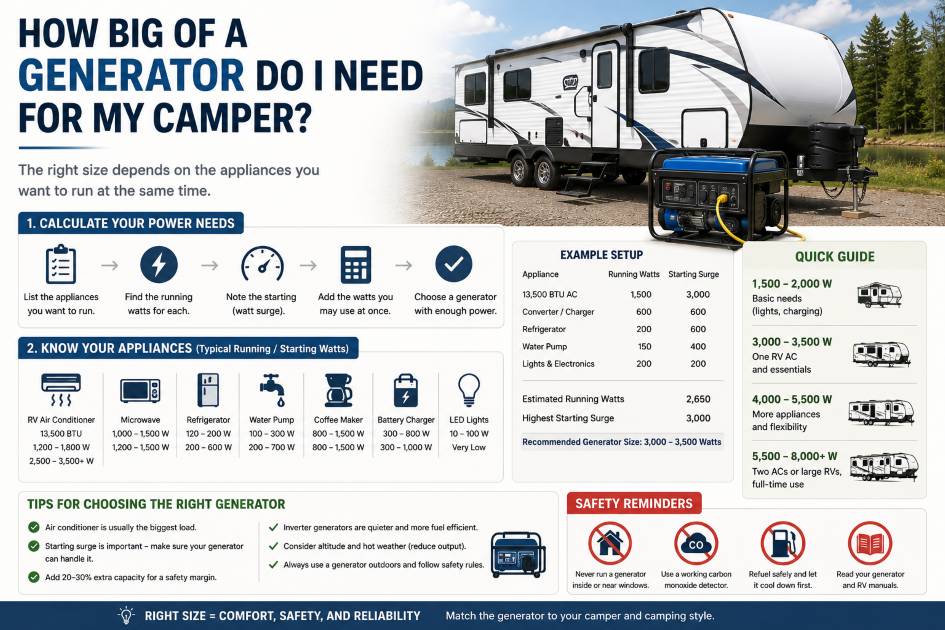
The right generator size for your camper depends on what you want to run at the same time. For many small campers, a 2,000-watt generator can handle basic needs. For a camper with air conditioning, a 3,000 to 4,000-watt generator is usually a more realistic choice. Larger RVs with multiple air conditioners, microwave use, battery charging, and bigger appliances may need 5,500 watts or more.
The simple answer is this: size the generator around your biggest load, which is usually the air conditioner, then add the other appliances you want to use at the same time.
Why Generator Size Matters
A generator that is too small will struggle, overload, shut down, or fail to start larger appliances. A generator that is much bigger than needed can cost more, use more fuel, create more noise, and take up more storage space.
The goal is not to buy the biggest generator possible. The goal is to choose a generator that matches your real camper use.
Understanding Watts
Generator size is measured in watts.
There are two important numbers:
- Running watts
- Starting watts
Running watts are what an appliance needs after it is already operating.
Starting watts are the extra power needed for a short moment when a motor or compressor starts.
Air conditioners, refrigerators, water pumps, and some power tools may need a higher starting surge.
This is why a generator can look strong enough on paper but still fail to start an RV air conditioner.
Common Camper Appliance Wattage
Actual numbers vary by model, but these are useful general ranges:
| Appliance | Approximate Running Watts | Possible Starting Surge |
|---|---|---|
| LED lights | 10 to 100 watts | Low |
| Phone/laptop charging | 50 to 200 watts | Low |
| RV refrigerator control board | Low | Low |
| 12V battery charging | 200 to 800 watts | Low to moderate |
| Water pump | 100 to 300 watts | Moderate |
| Microwave | 1,000 to 1,500 watts | Moderate |
| Coffee maker | 800 to 1,500 watts | Low to moderate |
| Electric heater | 1,500 watts | Low |
| Hair dryer | 1,200 to 1,800 watts | Low |
| 13,500 BTU RV AC | 1,200 to 1,800 watts | Often 2,500 to 3,500+ watts |
| 15,000 BTU RV AC | 1,500 to 2,000 watts | Often 3,000 to 4,000+ watts |
Always check the labels on your actual appliances. Different campers and appliance models can vary a lot.
Generator Size by Camper Use
Basic Camping Without Air Conditioning
If you only need lights, battery charging, small electronics, and maybe a small appliance, a compact generator may be enough.
Good range:
1,500 to 2,000 watts
This can work for:
- Charging batteries
- Running lights
- Charging phones and laptops
- Small coffee maker use
- Light weekend camping
It is not ideal if you want to run an RV air conditioner.
Small Camper With One AC Unit
If your camper has one small or mid-size air conditioner, you usually need more power.
Good range:
3,000 to 3,500 watts
This is often enough for:
- One RV air conditioner
- Battery charging
- Lights
- Small electronics
- Some light appliance use
You may still need to manage loads. For example, running the AC and microwave at the same time may overload a smaller generator.
Larger Camper With More Appliances
If you want to run the air conditioner, microwave, coffee maker, converter charger, and other loads, you need more capacity.
Good range:
4,000 to 5,500 watts
This gives more flexibility and fewer overload problems.
Large RV or 50-Amp Camper
A 50-amp RV can theoretically use much more power than a small portable generator can provide. Many large RVs use built-in generators around 5,500 to 8,000 watts or more, depending on the setup.
Good range:
5,500 to 8,000+ watts
This may be needed for:
- Two air conditioners
- Larger battery charger
- Residential-style appliances
- Microwave or convection oven
- Bigger inverter systems
- More comfortable full-RV operation
Even then, you still may not be able to run everything at once unless the generator and wiring system are designed for it.
30-Amp vs 50-Amp Camper
A 30-amp camper uses a 120V connection. Maximum available shore power is about 3,600 watts.
That does not mean you always need a 3,600-watt generator, but it gives a useful reference point.
A 50-amp RV has much more available power because it uses two 120V legs. Full 50-amp RV service can supply up to about 12,000 watts.
Most portable generators do not fully replace 50-amp shore power. They usually give you enough power for selected appliances, not everything at once.
Air Conditioner Is the Main Deciding Factor
For most campers, the air conditioner decides the generator size.
A 13,500 BTU RV AC may run on around 1,200 to 1,800 watts after startup, but the startup surge can be much higher.
A 15,000 BTU AC often needs even more.
If your generator can handle running watts but not starting surge, the AC may hum, trip the generator, or fail to start.
Soft Start Can Help
A soft start device can reduce the startup surge of an RV air conditioner. This can sometimes allow a smaller generator to start and run the AC more reliably.
This does not magically create unlimited power, but it can help with one of the biggest generator problems: compressor startup load.
A soft start can be especially useful for:
- Small campers
- Portable inverter generators
- One-AC setups
- Boondocking
- Owners who want quieter and lighter generator options
Inverter Generator vs Conventional Generator
For campers, an inverter generator is often the better choice.
Inverter generators are usually:
- Quieter
- More fuel efficient at low load
- Better for electronics
- Easier to carry in smaller sizes
- Popular for campgrounds and boondocking
Conventional generators can be cheaper and powerful, but they are often louder and less pleasant for camping.
Noise matters. Many campgrounds have generator rules and quiet hours.
Portable Generator or Built-In Generator?
A portable generator is flexible and can be more affordable.
Good for:
- Small campers
- Travel trailers
- Occasional use
- Battery charging
- One AC with proper sizing
A built-in generator is more convenient but costs more and requires installation and maintenance.
Good for:
- Larger RVs
- Motorhomes
- Frequent generator use
- Full-RV power needs
- Owners who want push-button operation
How to Calculate the Size You Need
Use this simple method:
- List the appliances you want to run.
- Find the running watts for each one.
- Identify the largest starting surge load.
- Add the running watts you may use at the same time.
- Make sure the generator can handle the startup surge.
- Add extra margin so the generator is not always maxed out.
Example:
You want to run:
- 13,500 BTU AC
- Battery charger
- Lights
- Phone chargers
A 3,000 to 3,500-watt generator may work well, especially if the AC has a soft start.
But if you also want to run the microwave or coffee maker while the AC is running, you may need a larger generator or you will need to turn some appliances off.
Do Not Forget Battery Charging Load
Many RV owners forget the converter charger or inverter charger.
When your batteries are low, the charger can pull significant power from the generator. If you start the generator and the charger immediately begins working hard, it reduces the available power for other appliances.
This matters even more if you have a large lithium battery bank.
A modern lithium setup can accept a lot of charging current, which is good, but the generator and charger must be sized correctly.
Altitude and Heat Reduce Generator Performance
Generators can lose power in high elevation and hot weather. If you camp in the mountains, desert, or hot summer conditions, do not size your generator with zero margin.
A generator that works fine at sea level may struggle at higher elevations.
This is another reason to avoid buying the smallest possible generator for your needs.
Fuel Type Matters
Camper generators may use:
- Gasoline
- Propane
- Diesel
- Dual-fuel gasoline and propane
Gasoline generators are common and easy to find.
Propane burns cleaner and stores well, but a generator may produce less power on propane than on gasoline.
Diesel is common in larger diesel motorhomes with built-in generators.
Dual-fuel generators are flexible, but check the watt rating for each fuel type because they are often different.
Safety Is Critical
Never run a generator inside the camper, under the RV, in a storage compartment, near an open window, or close to a door.
Generators produce carbon monoxide, which can be deadly.
Safe generator habits include:
- Run it outside only
- Keep exhaust away from windows and doors
- Use a working carbon monoxide detector
- Keep the generator dry
- Use proper cords and adapters
- Do not overload it
- Follow campground rules
- Let it cool before refueling
- Store fuel safely
Do not take shortcuts with generator safety.
Quick Generator Size Guide
| Camper Setup | Practical Generator Size |
|---|---|
| Lights, charging, small electronics only | 1,500 to 2,000 watts |
| Small camper, no AC, light appliances | 2,000 to 2,500 watts |
| One RV AC unit | 3,000 to 3,500 watts |
| One AC plus more appliance flexibility | 4,000 to 4,500 watts |
| Large camper or heavier use | 5,000 to 5,500 watts |
| Large RV with two AC units | 5,500 to 8,000+ watts |
This is a practical guide, not a replacement for checking your exact camper and appliance ratings.
Common Mistakes
Avoid these mistakes when choosing a camper generator:
- Buying based only on running watts
- Ignoring AC startup surge
- Forgetting the battery charger load
- Trying to run everything at once
- Buying a loud generator for campground use
- Using unsafe extension cords
- Running a generator too close to the RV
- Assuming a 50-amp RV can run fully on a small portable generator
- Not considering altitude and hot weather
- Not maintaining the generator
A generator should match your real camping style, not just the lowest price.
Custom way Can Help With Camper Generator Setup
At Custom way, we help RV and camper owners choose, install, service, and troubleshoot generator and electrical systems.
We can help with:
- RV generator sizing advice
- Generator service
- Built-in generator diagnostics
- Portable generator setup guidance
- Transfer switch inspection
- Inverter installation
- Battery and solar upgrades
- Lithium battery systems
- Soft start installation for RV air conditioners
- Shore power and charging diagnostics
- Full RV electrical system upgrades
A generator is only one part of the power system. Your batteries, inverter, charger, solar, wiring, transfer switch, and appliances all need to work together.
For basic camper use without air conditioning, a 2,000-watt generator may be enough. For a camper with one RV air conditioner, plan on around 3,000 to 3,500 watts. If you want to run the AC plus other appliances with fewer limitations, 4,000 to 5,500 watts is more comfortable. Large RVs with two air conditioners may need 5,500 to 8,000 watts or more.
The best generator size depends on your actual appliances, starting surge, battery charger load, and how much you want to run at the same time.
If you are not sure, Custom way can inspect your camper’s electrical setup and help choose a generator solution that works safely and reliably.