
How Does a Pop Up Camper Work?
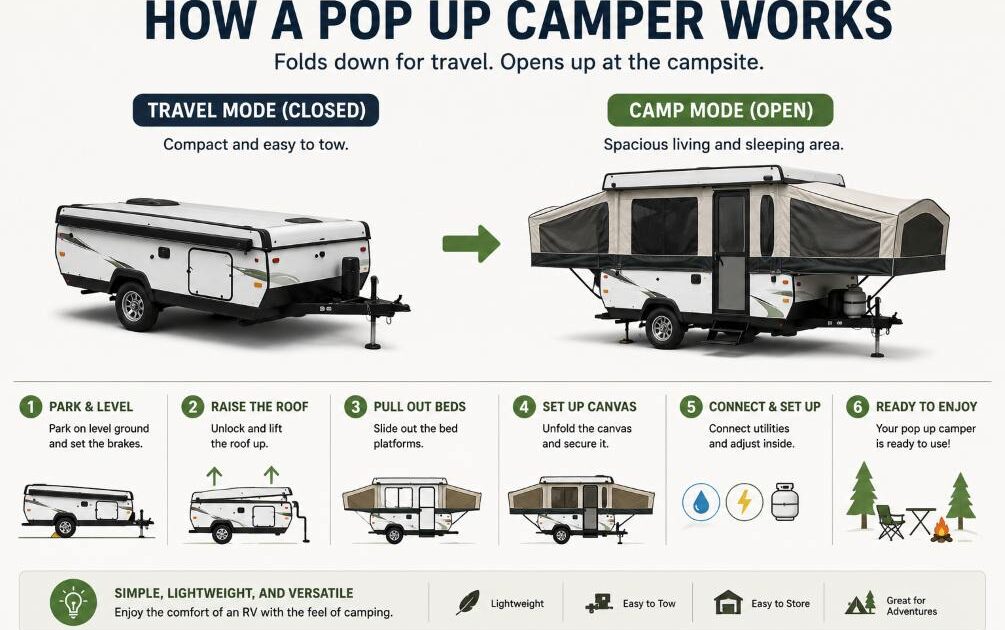
A pop up camper works by folding down into a compact trailer for towing, then expanding at the campsite to create sleeping and living space. The roof lifts up, the bed platforms slide out, and the canvas or tent-style walls unfold to create the upper part of the camper.
It is basically a mix between a travel trailer and a tent. You tow it like a small trailer, but when you park, it opens into a larger camping space.
What Happens When It Is Closed?
When a pop up camper is closed for travel, it sits low and compact.
In travel mode:
- The roof is lowered
- Canvas is folded inside
- Beds are pushed in
- Door sections are stored or folded
- Interior furniture stays inside the lower box
- The camper is easier to tow and store
This low profile is one of the biggest advantages. It creates less wind resistance than a full-height trailer and can often fit in a garage or driveway more easily.
How It Opens at the Campsite
Most pop up campers follow a simple setup process.
First, you park and level the camper. Then you stabilize it with jacks. After that, you raise the roof using a crank system, electric lift, or hydraulic-style lift depending on the model.
Once the roof is up, you pull out the bed platforms. The canvas unfolds with the beds and roof. Support poles or braces hold everything in place.
Then you set up the door, adjust the canvas, connect utilities if needed, and the camper is ready to use.
Main Parts of a Pop Up Camper
A pop up camper usually has these main systems:
- Lower trailer box
- Lift system
- Roof
- Canvas walls
- Fold-out bed platforms
- Stabilizer jacks
- Dinette or small seating area
- Small cabinets
- Electrical system
- Battery
- Shore power connection
- Sink or small water system in some models
- Stove or outdoor kitchen in some models
- Furnace or AC in some models
Not every pop up camper has the same features. Basic models are closer to tent camping. Larger models can have a small fridge, heater, sink, toilet, or even a compact shower.
Manual Lift vs Power Lift
Older and simpler pop up campers often use a manual crank. You insert the crank handle and raise the roof by turning it.
Newer or more equipped models may have a power lift. You press a switch and the roof lifts using an electric motor.
A power lift is easier, but it depends on battery condition and working wiring. A manual lift is slower but simpler.
How the Beds Work
The sleeping areas usually slide out from the front and rear of the camper.
These beds are supported by metal rails, cables, braces, or support poles. The canvas wraps around them to create tent-style sleeping areas.
This is why a small closed trailer can become surprisingly large when opened.
How the Canvas Works
The canvas is attached between the roof and lower camper body. When the roof lifts, the canvas rises with it. When the beds slide out, the canvas expands around the sleeping areas.
The canvas gives the camper its open, airy feel, but it also needs care. It must be dried before storage, cleaned gently, and checked for leaks, mildew, tears, and bad seams.
How Utilities Work
A pop up camper may have simple utility systems.
Electrical power can come from:
- Camper battery
- Tow vehicle while driving, depending on wiring
- Shore power at a campsite
- Solar panel if installed
Water can come from:
- Small fresh water tank
- City water hookup
- Hand pump or electric pump, depending on model
Some pop up campers also have propane for a stove, furnace, or small fridge.
What Makes It Different From a Travel Trailer?
A travel trailer has hard walls and stays full height all the time. A pop up camper folds down.
That means a pop up camper is usually:
- Lighter
- Lower when towing
- Easier to store
- More tent-like
- Less insulated
- More setup work
- Less secure than a hard-wall camper
A travel trailer is more comfortable in bad weather. A pop up camper feels more open and closer to real camping.
Common Setup Mistakes
Avoid these mistakes:
- Raising the roof before leveling the camper
- Forgetting to unlock roof latches before lifting
- Forcing the lift system
- Pulling beds out before the roof is high enough
- Closing the camper with wet canvas
- Forgetting support poles
- Overloading bed platforms
- Not checking canvas folds before lowering the roof
- Ignoring bad cables or lift system noises
The lift system should move smoothly. If it feels stuck, stop and inspect it.
Custom way Can Help
Custom way can help with pop up camper repairs, upgrades, electrical work, flooring, roof leak repair, lighting, battery systems, water system repairs, soft floor repair, interior remodeling, and full camper renovation projects.
A pop up camper is simple compared with a large motorhome, but it still has important systems. The lift mechanism, canvas, roof, flooring, wiring, and seals all need to work correctly.
A pop up camper works by folding down into a small trailer for towing and opening up at the campsite. The roof lifts, the bed platforms slide out, and the canvas expands to create sleeping and living space.
It is a practical choice for people who want something lighter and cheaper than a full travel trailer, but more comfortable than a tent.