
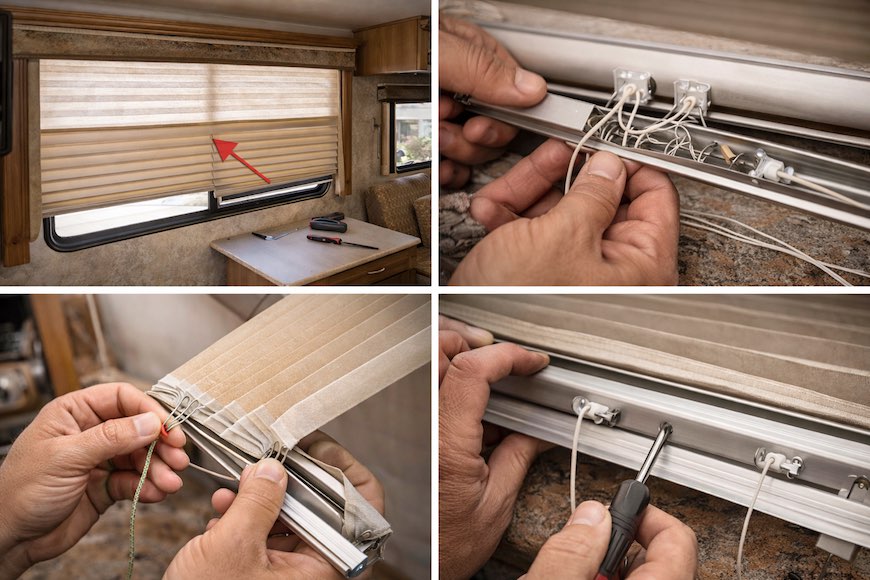
RV blinds break far more often than people expect. Constant vibration, temperature changes, and lightweight hardware all take a toll. The good news is that most RV blind problems are mechanical and can be fixed without buying new blinds or tearing half the wall apart.
The key is understanding what type of blinds you have and what actually failed.
Identify what type of RV blinds you’re dealing with
Most RVs use lightweight blinds designed specifically for mobile use. The most common ones are day night pleated blinds, roller shades, mini blinds, and cassette-style blinds with side tracks. Each fails in different ways, so guessing usually leads to wasted time.
Day night pleated blinds are by far the most common and also the most repairable.
Common RV blind problems and what causes them
Blinds won’t stay up
This is the most frequent complaint. In day night blinds, this almost always means the internal strings have stretched, slipped, or broken. It is not a spring problem and not a wall-mount issue.
On roller shades, this usually points to a weak or dirty spring mechanism inside the roller tube.
Blinds are uneven or crooked
If one side hangs lower than the other, the cords are no longer balanced. This happens gradually from vibration or suddenly if a string snaps. The blind itself is usually fine.
Trying to force it level almost always makes it worse.
Blinds won’t go down smoothly
This usually means cords are twisted, rubbing inside the rail, or partially frayed. Dirt and dust also play a role, especially in older rigs.
For roller shades, this can be caused by spring tension being too tight or too loose.
Broken clips, brackets, or mounts
Plastic mounting hardware becomes brittle over time. When blinds fall off the wall, the blind is rarely the problem. The mount failed first.
In many cases, upgrading the mounting hardware solves repeated failures.
Fixing day night RV blinds
Day night blinds are surprisingly serviceable.
The repair usually involves:
-
removing the blind from the wall
-
opening the bottom rail
-
re-threading or replacing the lift strings
-
equalizing tension on both sides
Replacement string kits are inexpensive, and the repair is mostly about patience, not skill. As long as the fabric is intact, the blind can usually be restored.
Fixing roller shades
Roller shades fail differently.
If the shade snaps up too fast or won’t retract, the spring tension needs adjustment. This is done by carefully removing the shade and rotating the roller tube in controlled turns.
If the fabric pulls out of the tube or tears, replacement is often the better option.
When cleaning fixes the problem
Many blinds feel broken but are just dirty.
Dust inside tracks, bottom rails, and cord guides creates drag. A careful cleaning with compressed air or a soft brush can restore smooth operation.
Avoid lubricants unless specified. Most blind mechanisms are designed to run dry.
When replacement actually makes sense
Repair is usually worth it unless:
-
the fabric is torn or delaminated
-
multiple cords are broken and brittle
-
the head rail is bent
-
UV damage has weakened the material
In those cases, repair becomes temporary at best.
Preventing repeat failures
RV blinds last longer when:
-
they are secured before travel
-
windows are not slammed shut with blinds down
-
cords are kept clean
-
blinds are not forced when stuck
Most failures happen during driving, not when parked.
Professional RV blind repair
If blinds are integrated into valances, side tracks, or custom cabinetry, removal can be tricky. Custom-way helps RV owners repair or replace blinds without damaging walls or trim, and can upgrade mounting hardware to prevent repeat issues.
This is especially useful in motorhomes where blinds are tied into the interior finish.
Most RV blind problems are mechanical, not structural. If the blind fabric is still good, repair is usually possible and worth doing. Slow, careful work beats forcing anything. When blinds are fixed correctly, they often work better than they did from the factory.