
How to Prime an RV Water Pump
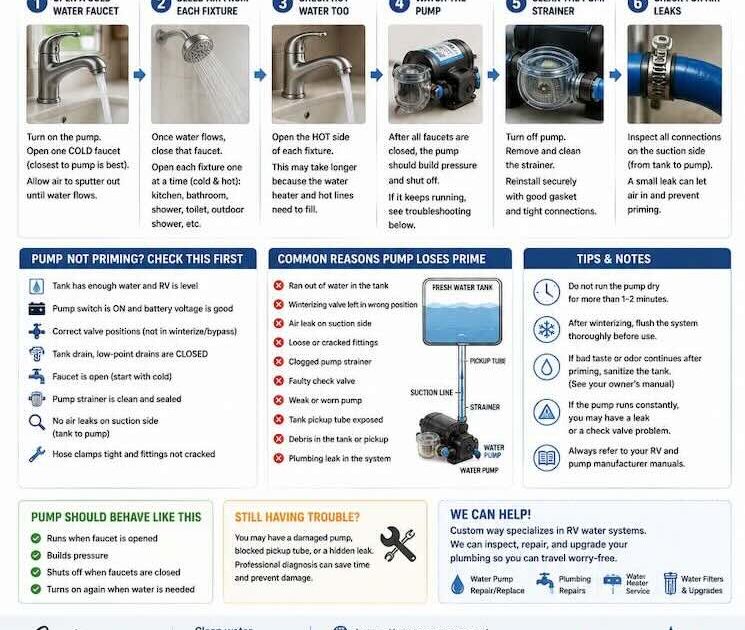
If your RV water pump is running but no water comes out of the faucet, the pump may have lost prime. This often happens after winterizing, draining the fresh water tank, replacing a pump, cleaning the filter, or letting the tank run completely dry.
Most RV fresh water pumps are designed to self-prime, but they still need the right conditions to pull water from the tank. If there is air in the line, a closed valve, a clogged strainer, or a small leak on the suction side, the pump may run without building pressure.
Here is how to prime an RV water pump step by step.
 What Does It Mean to Prime an RV Water Pump?
Priming means getting water into the pump and suction line so the pump can start moving water through the RV plumbing system.
When the pump is properly primed, it should:
- Pull water from the fresh water tank
- Push water through the cold and hot water lines
- Build pressure
- Shut off automatically when faucets are closed
- Turn on only when water is being used
If the pump runs continuously and no water comes out, it is not building pressure.
Step 1
Make Sure There Is Water in the Fresh Tank
Start with the obvious check.
Your fresh water tank must have enough water for the pump pickup tube to reach it. A small amount of water at the bottom of the tank may not be enough, especially if the RV is parked on a slope.
Add water to the fresh tank before testing the pump. For priming, it is better to have at least one-third of the tank filled.
Also make sure you are not accidentally trying to run the pump while connected only to city water. The onboard pump normally pulls from the fresh water tank, not from the city water inlet.
Step 2
Check the Valve Positions
Many RV water systems have valves for winterizing, tank fill, bypass, water heater bypass, or antifreeze suction.
If one valve is in the wrong position, the pump may pull air instead of water.
Check:
- Fresh tank valve
- Winterizing valve
- Antifreeze pickup hose valve
- Water heater bypass valves
- Low-point drain valves
- Tank drain valve
- Any shutoff valve near the pump
This is a very common issue after winter storage. The pump may be working fine, but the winterizing valve is still set to pull from the antifreeze tube instead of the tank.
Step 3
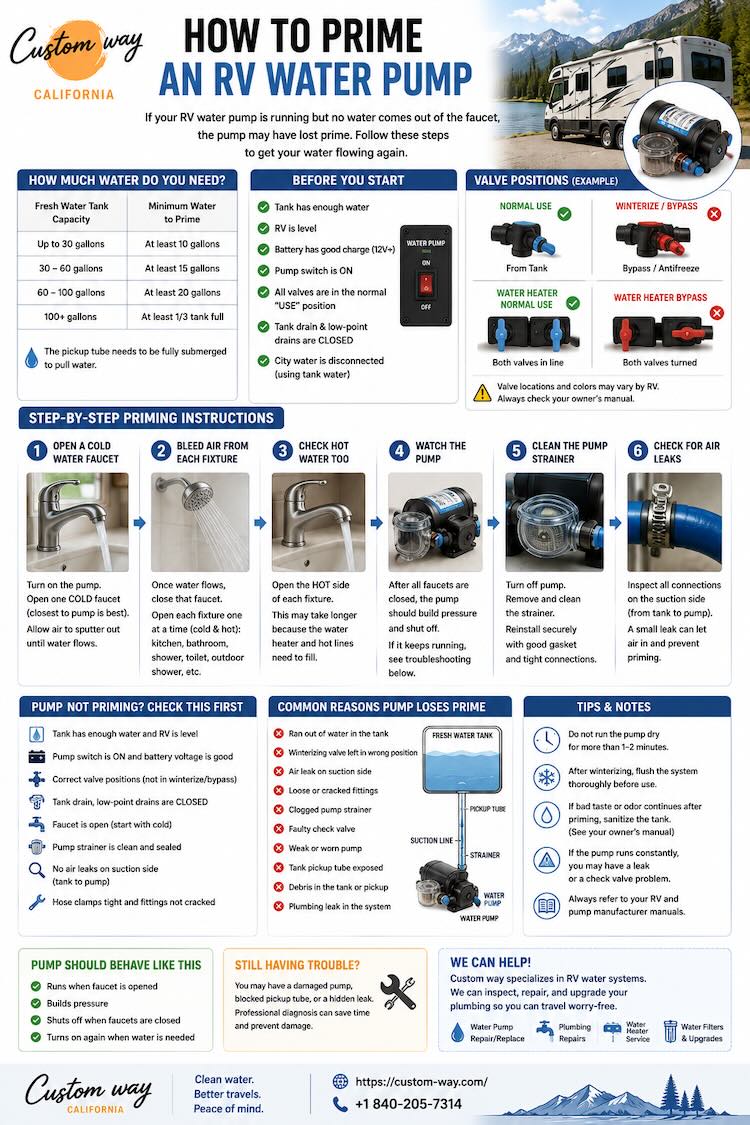
Open a Cold Water Faucet
Turn on the pump and open one cold water faucet.
Start with the faucet closest to the pump if possible. Cold water is usually easier to purge first because it does not need to fill the water heater.
Let the pump run briefly while the faucet is open. You may hear air sputtering before water starts flowing.
Once water flows steadily from that faucet, close it and move to the next fixture.
Step 4
Bleed Air From All Water Lines
After the first faucet starts flowing, open each fixture one at a time.
Run water through:
- Kitchen faucet
- Bathroom sink
- Shower
- Toilet
- Outdoor shower
- Any extra faucet or water outlet
Do both cold and hot sides. The hot side may take longer because the water heater tank and hot lines may need to fill.
You may hear coughing, sputtering, and uneven flow at first. That is normal while air is leaving the lines.
Step 5
Watch the Pump Behavior
Once all faucets are closed, the pump should build pressure and shut off.
A properly primed pump should not run constantly.
If the pump keeps running after all faucets are closed, possible causes include:
- Air still trapped in the system
- Low water level in the fresh tank
- Loose fitting on the suction side
- Clogged pump strainer
- Cracked strainer bowl
- Leak in plumbing
- Bad check valve
- Weak pump
- Pressure switch problem
Do not ignore a pump that runs continuously. It can overheat, drain the battery, and hide a leak.
Step 6
Check the Pump Strainer
Most RV water pumps have a small filter or strainer on the inlet side. Its job is to keep debris from entering the pump.
If the strainer is clogged, the pump may not prime correctly.
Turn off the pump before opening the strainer. Place a towel under it because water may spill out.
Check for:
- Sand
- Plastic shavings
- Sediment
- Cracked clear bowl
- Damaged rubber gasket
- Loose connection
Clean the strainer and reinstall it carefully. A small air leak at the strainer can stop the pump from pulling water.
Step 7
Check for Air Leaks on the Suction Side
The suction side is the plumbing between the fresh water tank and the pump inlet.
A tiny leak here may not drip water, but it can let air into the line. When that happens, the pump loses prime or runs without pressure.
Inspect:
- Hose clamps
- Threaded fittings
- Pump inlet connection
- Strainer gasket
- Winterizing valve
- Pickup hose
- Cracked plastic fittings
If the pump sounds like it is running fast but not moving water, air leakage on the inlet side is one of the first things to check.
Step 8
Make Sure the Battery Has Enough Power
RV water pumps are usually 12V DC. If the battery is weak, the pump may run slowly and fail to build proper pressure.
Check battery voltage or plug into shore power if needed.
Low voltage can make the pump sound weak, pulse strangely, or stop before priming properly.
If your pump only works well when plugged in, the problem may be battery condition, wiring, fuse connection, or voltage drop.
Step 9
Do Not Run the Pump Too Long Dry
Many RV pumps can tolerate brief dry running, but that does not mean you should let them run endlessly with no water.
If no water appears after a short attempt, turn the pump off and inspect the system.
Repeated long dry runs can cause heat, wear, and unnecessary stress on the motor and diaphragm.
Quick Priming Checklist
If your RV water pump will not prime, check this order:
- Fresh water tank has enough water
- RV is level enough for the pickup tube to reach water
- Pump switch is on
- Battery voltage is good
- Winterizing valve is in the correct position
- Tank drain and low-point drains are closed
- One cold faucet is open
- Pump strainer is clean and sealed
- Inlet fittings are tight
- No air leak exists between tank and pump
Most priming problems are caused by one of these items.
Why Your RV Water Pump Loses Prime
An RV pump can lose prime for several reasons:
- Fresh tank ran dry
- RV was winterized
- Pump strainer was opened
- Pump was replaced
- Air entered through a loose fitting
- Tank pickup tube is exposed
- Valve is set incorrectly
- Debris blocks the inlet
- Pump is mounted too high or too far from the tank
- Pump diaphragm is worn
If the pump loses prime again soon after you fix it, look for a recurring air leak or failing pump component.
When Priming Does Not Work
If you followed the basic steps and the pump still does not prime, the issue may be more serious.
Possible problems include:
- Damaged pump diaphragm
- Failed internal check valve
- Cracked pump head
- Blocked pickup tube inside the tank
- Broken fitting at the tank
- Bad wiring or voltage drop
- Incorrect pump installation
- Plumbing modification from a previous owner
At that point, the best move is proper diagnosis instead of replacing random parts.
Custom way Can Help With RV Water Pump Problems
At Custom way, we help RV owners diagnose and repair fresh water system problems, including pumps that will not prime, pumps that run constantly, weak water pressure, leaks, bad valves, and damaged plumbing.
We can help with:
- RV water pump troubleshooting
- Water pump replacement
- Pump strainer cleaning and replacement
- Fresh water tank line inspection
- Leak detection
- Valve correction after winterizing
- Water pressure problems
- Plumbing repair
- Faucet and shower upgrades
- Full RV water system service
A water pump issue is not always just a pump issue. Sometimes the real problem is a valve, suction leak, clogged filter, cracked fitting, or poor wiring. We inspect the whole system so the repair actually solves the problem.
Final Answer
To prime an RV water pump, fill the fresh water tank, check that all valves are in the normal use position, turn on the pump, open a cold faucet, and let the air purge until water flows steadily. Then repeat the process through each faucet, including hot and cold sides.
If the pump still will not prime, check the inlet strainer, suction-side fittings, winterizing valve, battery voltage, and fresh tank pickup line.
A properly primed RV water pump should build pressure, shut off when faucets are closed, and turn on only when water is being used.