
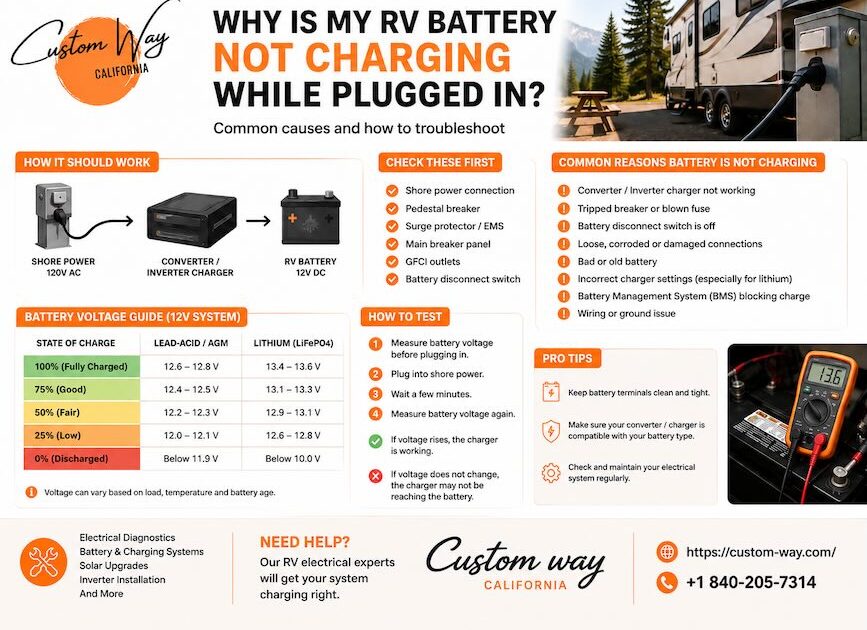
If your RV battery is not charging while plugged in, the problem is usually somewhere between shore power, the converter charger, wiring, fuses, breakers, or the battery itself. In a normal RV setup, plugging into shore power should supply 120V AC power and allow the converter or inverter charger to recharge the 12V battery system.
When that does not happen, the RV may still have working outlets and appliances, but the battery can slowly drain in the background. That makes the issue confusing for many owners.
The good news is that the problem can usually be narrowed down step by step.
How RV Battery Charging Should Work
When you plug your RV into shore power, the electrical system should do two things:
- Supply 120V AC power to outlets, microwave, air conditioner, and other AC appliances.
- Use the converter charger or inverter charger to charge the 12V battery system.
The 12V battery powers lights, water pump, furnace fan, control boards, slide systems, leveling systems, and many other RV functions.
So even when the RV is plugged in, the battery still matters. If the converter is not charging it, your 12V system may eventually shut down.
First Check: Is the RV Actually Getting Shore Power?
Start with the simplest question. Is shore power really reaching the RV?
Check:
- Campground pedestal breaker
- Power cord connection
- Surge protector or EMS display
- Main RV breaker panel
- Any tripped GFCI outlet
- Loose or burned plug connections
Sometimes the RV looks plugged in, but the pedestal breaker is off, the cord is not fully seated, or the surge protector has blocked power because of low voltage or wiring faults.
If your 120V outlets are not working, the problem may be shore power, not the battery charger.
The Converter Charger May Not Be Working
The most common reason an RV battery is not charging while plugged in is a failed or inactive converter charger.
The converter takes 120V AC power and converts it into 12V DC power to charge the batteries and run the RV’s 12V loads.
Signs of a converter problem:
- Battery voltage does not rise when plugged in
- 12V lights get dimmer over time
- Battery drains even while connected to shore power
- Converter fan never runs
- Converter breaker is tripped
- Blown fuses near the converter
- Burning smell or overheating
A working charger should usually raise battery voltage above resting voltage. For many lead-acid or AGM systems, you may see around 13.2V to 14.4V depending on charge stage. For lithium systems, the charging voltage may be different depending on charger settings and battery type.
If the battery stays at the same voltage before and after plugging in, the converter may not be charging.
Check the Battery Disconnect Switch
Many RVs have a battery disconnect switch near the entry door, battery compartment, or control panel.
If this switch is off, the battery may be disconnected from part of the charging system.
This can cause strange symptoms:
- Shore power works
- Outlets work
- Some 12V systems work
- Battery still does not charge
Make sure the battery disconnect is in the correct position. Some RVs label it as “use/store,” which can be confusing. In most cases, the RV needs to be in “use” mode for normal battery charging.
Blown Fuses Can Stop Charging
RV charging circuits often include fuses between the converter and battery. Some systems also have reverse polarity fuses that blow if the battery was connected incorrectly.
Check for:
- Blown converter fuses
- Battery inline fuse
- DC distribution panel fuses
- Reverse polarity fuses
- Loose fuse holders
- Corroded terminals
A fuse can look fine at first glance but still be bad. Testing with a multimeter is better than relying only on visual inspection.
Tripped Breakers Can Shut Down the Charger
Your converter or inverter charger usually needs 120V AC power to operate. If its breaker is tripped, the charger will not work even if the RV is plugged in.
Check the main breaker panel and reset any tripped breaker fully.
Important: a breaker can look like it is on when it is actually tripped. Turn it fully off, then back on.
If the breaker trips again, do not keep resetting it. That may indicate a short, overload, failing converter, or wiring issue.
The Battery Itself May Be Bad
Sometimes the charger is working, but the battery cannot accept or hold a charge.
This is common with old lead-acid or AGM batteries.
Signs of a failing battery:
- Voltage drops quickly after charging
- Battery gets hot during charging
- Swollen battery case
- Rotten egg smell from flooded lead-acid battery
- Battery shows full voltage but fails under load
- Battery is several years old and deeply discharged often
A deeply discharged battery may also confuse some modern chargers. Some chargers will not start properly if battery voltage is extremely low.
If the battery is damaged, charging system repair alone will not solve the problem.
Corroded or Loose Battery Connections
Bad connections can stop charging even when all major components are working.
Inspect:
- Battery terminals
- Ground cable
- Converter positive cable
- Frame ground connection
- Battery lugs
- Inline fuse connections
- Cable ends hidden under covers
Corrosion increases resistance. A loose ground can make the whole system behave unpredictably.
If you see white, green, or dark corrosion around terminals, clean and tighten the connections. If cables are damaged or overheated, they should be replaced.
Lithium Battery Charging Issues
Lithium batteries are great for RV use, but they need the right charging setup.
Common lithium charging problems include:
- Old converter not compatible with lithium
- Charger set to lead-acid mode
- Battery BMS blocking charge
- Low temperature charge protection activated
- Wrong voltage settings
- Undersized wiring
- Poor grounding
- Battery monitor not calibrated
Many lithium batteries should not be charged below freezing unless they have internal heating or a system designed for cold-weather charging. If the battery management system blocks charging, the RV may appear to have a charger problem when the battery is actually protecting itself.
If you upgraded to lithium but kept the original converter, that may be the reason the battery is not charging correctly.
Inverter Charger Settings May Be Wrong
Some RVs use an inverter charger instead of a basic converter.
This system may have settings for:
- Battery type
- Charge current
- Shore power input limit
- Charger on/off mode
- Equalization mode
- Lithium profile
- Temperature compensation
If the charger is disabled in settings or configured incorrectly, the RV may be plugged in but not charging the battery.
This is common after battery upgrades, solar installation, or previous owner modifications.
Solar Can Make Diagnosis Confusing
If your RV has solar panels, battery voltage may rise during the day even if the shore charger is not working.
That can hide the real issue.
To test shore charging correctly, check voltage:
- Before plugging into shore power
- After plugging in
- With solar temporarily disconnected or at night if possible
If the battery only charges from solar but not from shore power, the converter charger or inverter charger circuit needs inspection.
How to Test If Your RV Battery Is Charging
You can do a basic test with a multimeter.
Step 1: Measure battery voltage before plugging in.
Step 2: Plug the RV into shore power.
Step 3: Wait a few minutes.
Step 4: Measure battery voltage again.
If voltage rises, the charger is probably working.
If voltage does not change, the charger may not be reaching the battery.
Example:
- 12.2V before plugging in and 13.6V after plugging in usually means charging.
- 12.2V before plugging in and still 12.2V after plugging in usually means no charging.
Voltage alone is not a perfect test, but it is a very useful first step.
Common Reasons Your RV Battery Is Not Charging While Plugged In
Here are the most likely causes:
- Shore power not reaching the RV
- Tripped breaker
- Failed converter charger
- Blown DC fuse
- Battery disconnect switch turned off
- Bad battery
- Loose or corroded battery cables
- Poor ground connection
- Incompatible lithium charger
- Inverter charger settings disabled
- Battery management system blocking charge
- Wiring damage between charger and battery
The right fix depends on which part of the system has failed.
When You Should Stop DIY Testing
Basic checks are fine, but stop and call a professional if you notice:
- Burning smell
- Melted wiring
- Hot battery cables
- Battery swelling
- Repeatedly tripping breaker
- Sparks at terminals
- Unknown previous wiring modifications
- Water damage near electrical components
RV electrical systems combine 120V AC and 12V DC power. Mistakes can damage equipment or create fire risk.
Custom Way Can Help With RV Battery Charging Problems
At Custom Way, we diagnose and repair RV battery charging problems properly instead of guessing.
We can help with:
- RV battery not charging diagnostics
- Converter charger testing and replacement
- Inverter charger inspection
- Lithium battery upgrade setup
- Battery monitor installation
- Solar charging system inspection
- Battery drain diagnosis
- Fuse, breaker, and wiring repair
- Ground connection repair
- Full RV electrical system upgrades
If your RV battery is not charging while plugged in, the problem may be simple, or it may be part of a larger electrical issue. We check the full charging path, from shore power to charger output to battery connections, so the repair actually solves the problem.
A Charging Problem Should Not Be Ignored
If your RV battery is not charging while connected to shore power, do not wait until the battery is completely dead. Deep discharge can shorten battery life and create more electrical problems.
Start with the simple checks: shore power, breakers, battery disconnect, fuses, and cable connections. If everything looks normal but the battery still does not charge, the converter, inverter charger, battery, or wiring needs proper testing.
A reliable charging system makes your RV easier to use, safer to travel with, and much more comfortable off-grid or at a campground.