
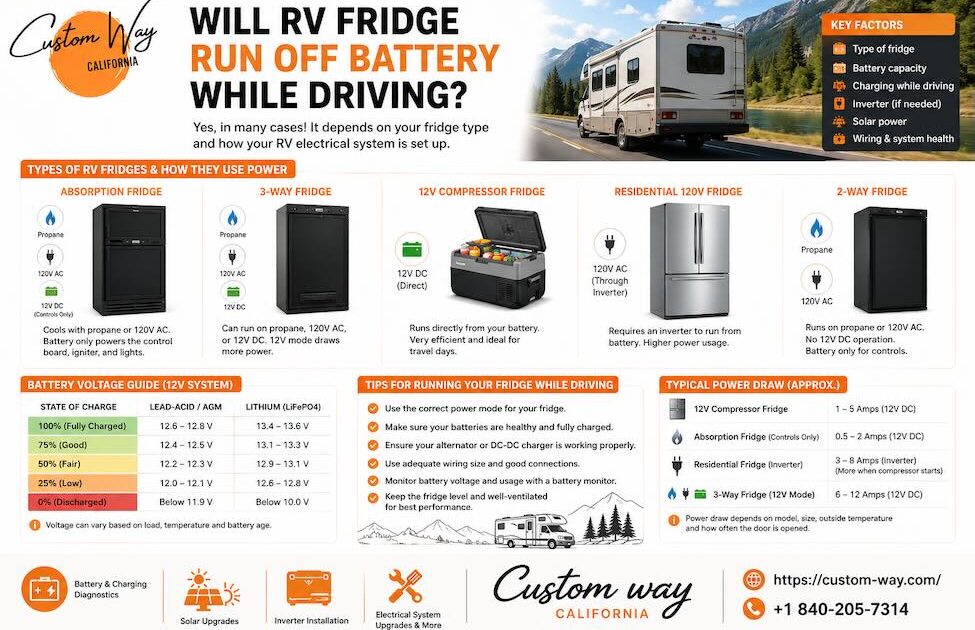
Yes, an RV fridge can run off battery while driving, but the real answer depends on what type of refrigerator your RV has and how the electrical system is wired.
Some RV fridges only need battery power for the control board while cooling with propane. Some can run directly on 12V DC. Others need an inverter to run from the battery because they are 120V residential-style refrigerators.
That is why two RV owners can ask the same question and get completely different answers.
The Type of RV Fridge Matters
Before you decide how to power your fridge on the road, you need to know what type of refrigerator is installed in your RV.
Most RVs use one of these systems:
- Absorption RV fridge
- 2-way RV fridge
- 3-way RV fridge
- 12V compressor fridge
- Residential 120V fridge with inverter
Each one handles battery power differently.
Absorption RV Fridge While Driving
Many traditional RV refrigerators are absorption fridges. They usually run on propane or 120V shore power.
When driving, these fridges may use battery power only for the control board, igniter, interior light, and safety electronics. The actual cooling may still come from propane.
So in this setup, the fridge is not really “running off the battery” in the full sense. The battery is supporting the electronics, while propane does the cooling.
This is common in older RVs and many travel trailers.
Can You Run an RV Fridge on Propane While Driving?
Many RV owners do it, and many RV refrigerators are designed to operate on propane. But there are safety concerns and location rules to consider.
You may need to turn propane off:
- At gas stations
- On ferries
- In some tunnels
- In certain restricted areas
- When required by local rules or facility policy
The main concern is open flame or ignition source near fuel vapors. If you use propane while driving, you should understand your RV system, keep it maintained, and follow all safety rules for your route.
If you do not want to rely on propane while driving, a 12V fridge or inverter-supported setup may be a better option.
12V RV Fridge While Driving
A 12V compressor fridge is the simplest answer for battery use.
It runs directly from the RV’s 12V battery system. While driving, the alternator or DC-DC charger can help keep the battery charged.
This type of fridge is becoming more popular because it is efficient, simple, and does not need propane for cooling.
A good 12V RV fridge setup may include:
- Lithium battery bank
- DC-DC charger from the vehicle alternator
- Solar panels
- Battery monitor
- Proper wire sizing
- Correct fuse protection
If the system is designed correctly, a 12V fridge can run while driving without draining the battery too aggressively.
3-Way RV Fridge While Driving
A 3-way fridge can usually run on:
- Propane
- 120V AC
- 12V DC
The 12V mode sounds convenient, but it can pull a lot of current. On some older systems, 12V fridge operation while driving works only if the alternator is providing enough charge.
If the wiring is weak or the battery charging system is poor, the fridge may drain the battery faster than expected.
This is why many 3-way fridge owners use 12V mode only during travel, not when parked.
Residential RV Fridge While Driving
Some modern RVs have residential-style refrigerators. These usually run on 120V AC power.
To use one while driving, the RV needs an inverter that converts battery power into 120V AC.
This setup can work well, but it needs enough battery capacity.
A residential fridge may run fine while driving if the RV has:
- A properly sized inverter
- Strong battery bank
- Alternator charging
- Solar charging
- Good wiring
- Battery monitor
Without these, the fridge can drain the battery quickly.
Will the Tow Vehicle Charge the RV Battery Enough?
Sometimes yes, but often not enough.
Many people assume that the truck or motorhome alternator fully charges the RV battery while driving. In reality, charging may be weak because of long cable runs, small wire size, voltage drop, factory limitations, or missing DC-DC charging equipment.
If your fridge runs from battery while driving, you should check whether your battery is actually receiving enough charge on the road.
A proper setup may need a DC-DC charger. This helps manage charging from the alternator to the RV battery bank more safely and efficiently.
How Long Can an RV Fridge Run on Battery?
It depends on battery size, fridge type, temperature, and charging sources.
A 12V compressor fridge is usually much more battery-friendly than running a large residential fridge through an inverter.
Things that affect runtime:
- Battery capacity
- Battery type, lead-acid, AGM, or lithium
- Fridge size
- Outside temperature
- How often the fridge door is opened
- Inverter efficiency
- Solar input
- Alternator charging
- Condition of wiring and connections
A small 12V fridge with lithium batteries and solar can run comfortably during travel. A residential fridge on a weak battery bank may cause problems much faster.
How to Tell If Your RV Fridge Is Running From Battery
Check the fridge control panel first.
Look for modes such as:
- LP gas
- Auto
- AC
- DC
- Battery
- 12V
Then check your battery monitor or voltage while the fridge is running.
If battery current drops sharply when the fridge turns on, the fridge is pulling from the battery system.
If the fridge is on propane, the battery draw may be small because it is only powering controls.
Common Problems While Running RV Fridge on Battery
RV owners often notice these issues:
- Battery drains while driving
- Fridge shuts off during travel
- Fridge works on shore power but not battery
- Fridge works on propane but not 12V
- Inverter overloads
- Alternator does not charge the house battery enough
- Battery voltage drops too low
- Fridge gets warm after several hours on the road
These problems usually come from weak charging, wrong fridge mode, bad wiring, poor battery capacity, or an electrical system that was never designed for the load.
Should You Upgrade Your RV Fridge Setup?
If you travel often, upgrading the fridge power system can make the RV much easier to use.
Good upgrades include:
- 12V compressor fridge installation
- Lithium battery upgrade
- DC-DC charger installation
- Solar panels
- Battery monitor
- Inverter upgrade
- Wiring and fuse protection improvements
- Electrical system inspection
The goal is simple: the fridge should stay cold while driving without killing the battery.
Custom way Can Help With RV Fridge and Battery Power
At Custom way, we help RV owners build reliable electrical systems for real travel conditions.
If your RV fridge does not stay cold while driving, drains the battery, or only works in one power mode, we can inspect the full system and find the real cause.
We can help with:
- RV fridge power diagnostics
- 12V fridge installation
- Lithium battery upgrades
- Solar system installation
- DC-DC charger installation
- Inverter setup
- Battery monitor installation
- Wiring repair and upgrades
- Full RV electrical system redesign
A fridge problem is often not just a fridge problem. It can be connected to the battery bank, charger, inverter, alternator charging, or old wiring.
So, Will an RV Fridge Run Off Battery While Driving?
Yes, but only if the fridge type and electrical system support it.
A 12V compressor fridge can run directly from the battery. A residential fridge needs an inverter. An absorption fridge may only use battery power for controls while propane does the cooling. A 3-way fridge can use 12V mode, but it may draw significant current.
The best setup is the one that keeps your food cold, protects the battery, and works safely while you travel.
If you are not sure how your RV fridge is powered, checking the system before a long trip is always smarter than finding out on the road.