How to Charge a Camper Battery From a Tow Vehicle
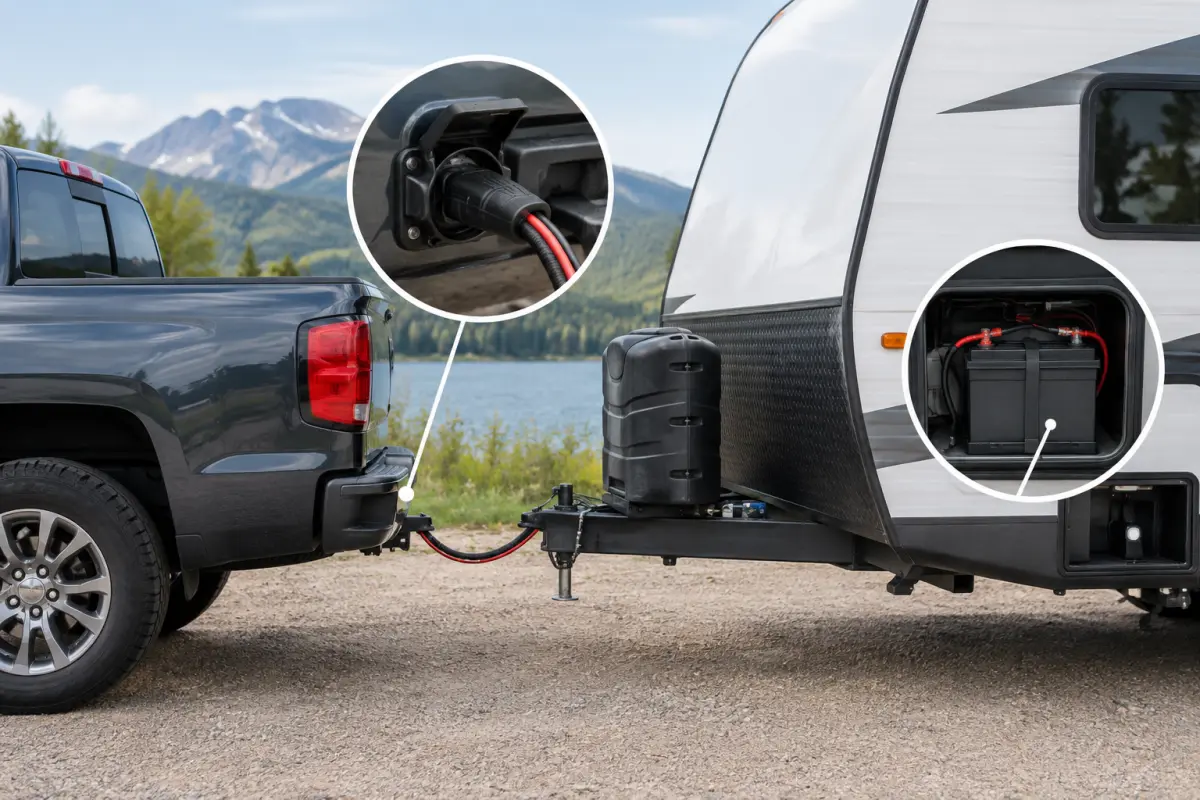
You can charge a camper battery from a tow vehicle through the auxiliary 12-volt circuit in a properly wired 7-way trailer connector. In most installations, this connection provides a maintenance charge while driving rather than a fast recharge of a deeply discharged battery.
For dependable charging, especially with a lithium battery, a long cable run, or a vehicle with a smart alternator, use a dedicated 12V-to-12V DC-DC charger. Custom way repairs and renovates RVs and camper vans in California, including electrical repairs and solar installations for customers in Orange County, Los Angeles, and Riverside County.
How the 7-way charging circuit works
The tow vehicle sends power through the auxiliary charging pin of the 7-way connector. The trailer-side wiring then carries that power to the camper battery or its charging system. The circuit must have:
- A correctly wired auxiliary 12-volt connection;
- Suitable positive wiring and a reliable ground return;
- Properly sized fuses or circuit breakers;
- Correct polarity at every connection;
- A camper charging circuit designed for the vehicle’s available voltage and current.
This arrangement can help maintain battery charge during a trip, but voltage drop through the vehicle, connector, and trailer wiring often limits the charging current. It may not fully recharge a battery that is substantially discharged.
Why a DC-DC charger is often the better solution
A dedicated DC-DC charger regulates the power from the tow vehicle and provides a charging profile suited to the camper battery. It is particularly useful when the vehicle has a modern smart alternator, because the alternator’s output voltage may vary while driving.
A DC-DC charger can also reduce the effects of long cable runs and voltage drop. The Victron Energy Orion XS 12/12-50A DC-DC battery charger is one example of a charger designed to charge a service battery from an engine-driven alternator. Its available output still depends on the power the alternator can provide.
Some installations use a separate engine-running, ignition, or enable signal. This signal tells the charger when the engine is operating and may be necessary for charging to work correctly with a smart alternator. Certain RV systems also use a dedicated Anderson-style connection instead of relying only on the 7-way plug.
Special considerations for lithium camper batteries
Do not connect a lithium camper battery directly to an unregulated tow-vehicle charge line. Lithium batteries require a compatible charging profile and correctly controlled voltage. Direct connection can damage the battery or create an unsafe electrical condition.
Use a suitable DC-DC charger or another properly regulated charging system, and follow the battery manufacturer’s charging limits. The charger’s output must match the battery capacity, wiring, connectors, fuses, alternator capability, and any battery-management-system requirements.
Typical installation layout
- Run correctly sized positive cable from the tow vehicle battery or an approved power source toward the rear of the vehicle.
- Install overcurrent protection close to the power source, using a fuse or circuit breaker appropriate for the cable and system.
- Connect the vehicle-side cable to the trailer charge circuit or to a dedicated high-current connector.
- Provide a suitable ground return rather than relying on an uncertain body or frame connection.
- Install the DC-DC charger in the camper when the system requires controlled charging.
- Connect an ignition or engine-running signal if required by the charger or vehicle.
- Check polarity, voltage, fuse placement, connector temperature, and voltage at the camper battery with the engine running.
The exact design depends on the tow vehicle, trailer connector, battery chemistry, battery capacity, alternator type, existing camper wiring, and cable length. There is no universal charging current for every 7-way installation.
What to check before modifying the system
- Read the tow vehicle and camper owner’s manuals.
- Confirm whether the 7-way auxiliary pin is powered and fused.
- Inspect the trailer plug, socket, ground, and existing charge wire.
- Measure voltage at the tow vehicle and camper ends under load.
- Verify that the alternator can support the charger’s requested output.
- Confirm that every fuse, cable, connector, and terminal is rated for the intended current.
A qualified automotive or RV electrician should verify the installation, especially when adding a DC-DC charger or working with lithium batteries. Custom way provides RV electrical repair, solar installation, and camper renovation services at 17223 Roseton Ave, Artesia 90701. The service area includes Orange County, Los Angeles, and Riverside County. Call +1 840-205-7314 or email customway.ca@gmail.com to discuss an RV charging-system repair or installation.