How to Hook Up 2 Batteries in a Camper
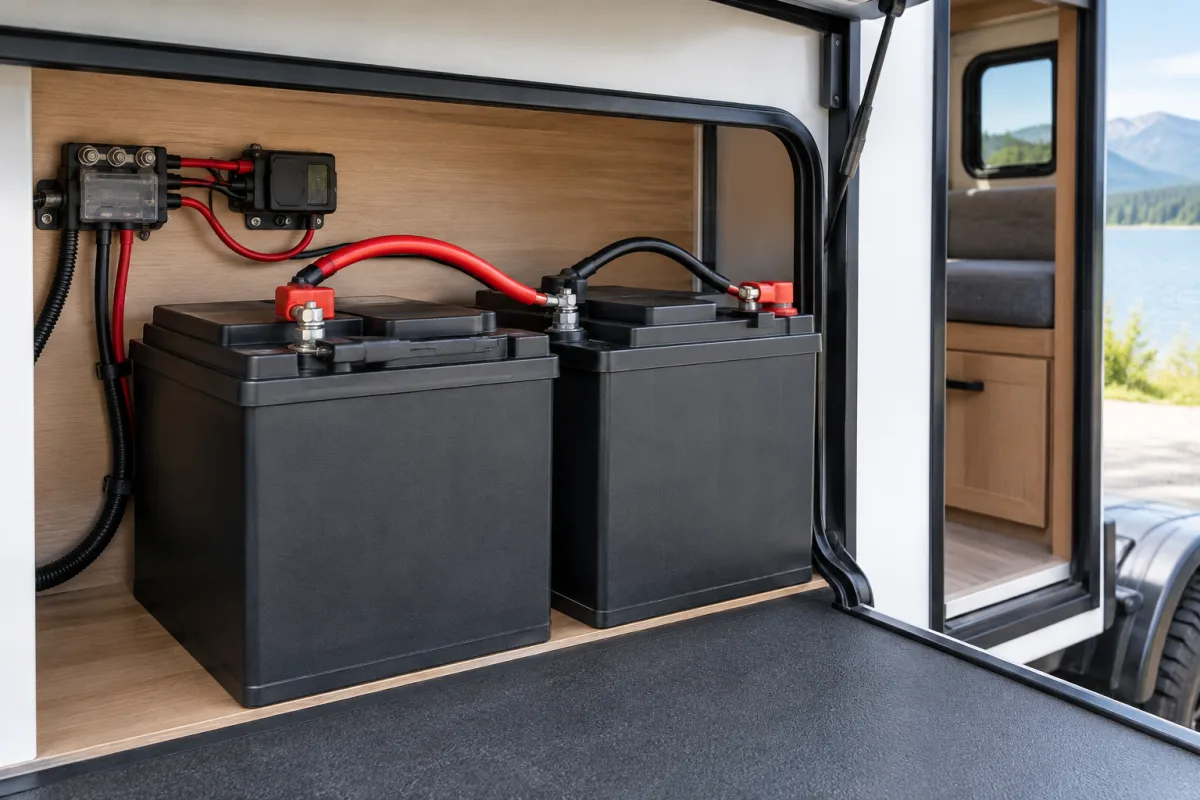
To connect two 12-volt batteries in a camper, wire them in parallel: connect positive to positive and negative to negative. The system remains 12 volts, while the available battery capacity and runtime increase. Use matching batteries, correctly sized cables, a properly rated fuse, and a safe connection layout.
Custom way repairs and renovates RVs and camper vans in California, including electrical repairs and solar installations. If the battery bank, charging system, or wiring needs professional attention, its team serves Orange County, Los Angeles, and Riverside County.
Connecting two 12-volt batteries in parallel
- Turn off the camper’s electrical loads and disconnect shore power. Switch off the inverter, solar charger, and battery disconnect if fitted.
- Confirm that both batteries are 12-volt units with the same chemistry, capacity, brand and model where possible, and a closely matching age and condition.
- Connect the positive terminal of Battery 1 to the positive terminal of Battery 2.
- Connect the negative terminal of Battery 1 to the negative terminal of Battery 2.
- Connect the camper’s positive supply cable to the positive side of one battery and the camper’s negative cable to the negative side of the other battery. Alternatively, use correctly rated positive and negative busbars.
- Install a fuse on the positive battery-bank cable as close to the battery as practical. Select the fuse and cable size according to the connected equipment, expected current, and the battery and camper manufacturer’s specifications.
- Check every connection for correct polarity and tightness before reconnecting loads or charging equipment.
With parallel wiring, voltage stays at approximately 12 volts. Two batteries with the same rated capacity provide roughly twice the total amp-hour capacity, although actual runtime depends on battery type, age, temperature, load, and the permitted depth of discharge.
Why the connection layout matters
Do not take both the camper’s positive and negative supply cables from the same battery unless the installation specifically calls for it. Taking the positive connection from one end of the bank and the negative connection from the opposite end helps balance resistance and current sharing. Properly rated busbars can provide the same organized arrangement.
Use equal-length interconnecting cables with an appropriate current rating. Unequal or undersized cables can increase voltage drop and cause the batteries to share charging and load current unevenly.
When two 6-volt batteries are used
Two 6-volt batteries are normally connected in series, not parallel, when a camper requires a 12-volt bank:
- Connect the positive terminal of the first battery to the negative terminal of the second.
- Use the remaining negative and positive terminals as the bank’s 12-volt output.
Series wiring adds voltage while the amp-hour capacity remains that of one battery. Never connect two 12-volt batteries in series unless the camper is specifically designed for a 24-volt electrical system.
Battery matching and lithium requirements
Do not mix batteries with different chemistry, nominal voltage, capacity, brand, model, or substantially different age. Mismatched batteries may charge unevenly, wear out faster, damage connected equipment, or create a safety risk.
Lithium batteries require additional care. The manufacturer’s instructions may require each battery to be fully charged before parallel connection and may specify that their voltages must be closely matched. Battery-management-system compatibility, the approved number of parallel batteries, charging settings, and disconnect procedures vary by model. Follow the battery manual rather than applying lead-acid wiring assumptions.
Safety checks before powering the camper
- Verify polarity with a meter before connecting the camper’s loads.
- Keep the positive cable protected by a fuse near the battery bank.
- Use cable insulation and terminals rated for the expected current.
- Prevent tools or metal objects from bridging battery terminals.
- Confirm that the converter, inverter, solar controller, and alternator charging system are configured for the battery chemistry.
- Check the manufacturer’s instructions for cable limits, charging requirements, and permitted battery combinations.
The exact fuse rating, cable gauge, charger settings, and disconnect method depend on the battery specifications and the camper’s electrical system. Custom way can inspect or repair camper electrical wiring and related RV systems in Orange County, Los Angeles, and Riverside County. The shop is located at 17223 Roseton Ave, Artesia 90701; phone +1 840-205-7314 and email customway.ca@gmail.com.