What Size Inverter Do I Need for My Camper?
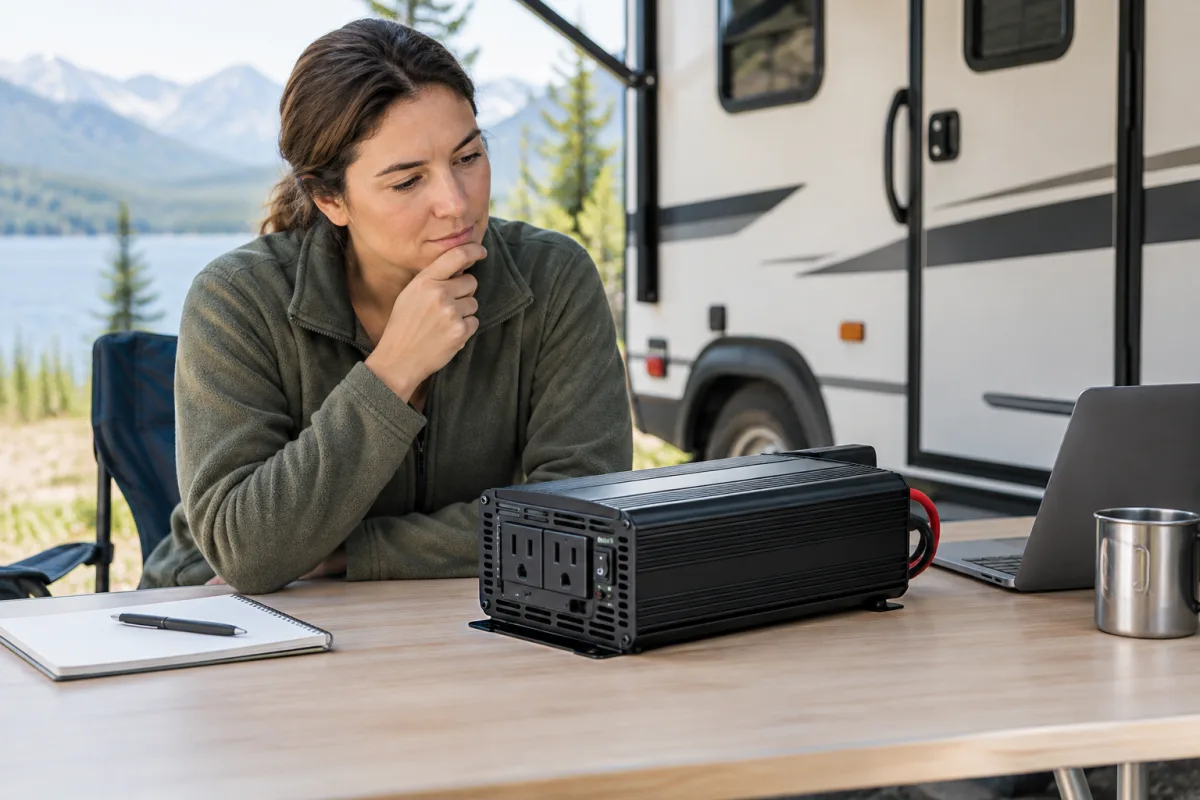
Most campers need a 1,000W to 2,000W pure sine wave inverter for everyday loads such as chargers, lighting, a television, a laptop, and small kitchen appliances. A larger inverter—often around 3,000W or more—may be necessary for high-power appliances such as an RV air conditioner.
The correct choice depends on the appliances you will use at the same time, their running wattage, startup surge, battery voltage, cable capacity, and an installation safety margin.
Choosing the inverter size
1,000W inverter
A 1,000W inverter can suit a smaller camper with modest electrical needs. It may handle lighting, phone and laptop chargers, a television, and other electronics when their combined demand remains below the inverter’s continuous rating.
2,000W inverter
A 2,000W inverter is a common choice for campers. It can support combinations such as a microwave, computer, television, and chargers, provided their combined running wattage and startup demand stay within the inverter’s limits.
3,000W or larger inverter
A 3,000W inverter may be needed for several high-demand appliances or equipment with substantial startup requirements. An RV air conditioner can require approximately 3,000W during startup, and some systems may call for a 3,500W to 4,000W inverter. The exact requirement varies by air-conditioner model.
How to calculate the required wattage
- List every appliance that might operate simultaneously.
- Record each appliance’s running wattage from its label or manufacturer specifications.
- Add the running wattages together.
- Identify appliances with motors, compressors, pumps, or heating elements and check their startup or surge requirements.
- Add a margin of about 20% to 25% to the calculated continuous load.
- Choose an inverter whose continuous rating and surge rating both exceed the result.
For example, if the appliances used at the same time total 1,400W, a 2,000W inverter may be appropriate if its surge capacity also covers the startup demands. This calculation is only an example; appliance specifications should determine the final selection.
Why startup surge matters
Refrigerators, air conditioners, pumps, compressors, and other motor-driven equipment can draw substantially more power when they start than they use while running. An inverter may have enough continuous capacity but still shut down if its surge rating is too low.
Check both ratings before buying: the continuous wattage shows what the inverter can supply over time, while the surge wattage covers short startup demands.
Choose a pure sine wave inverter
A pure sine wave inverter is generally the safer choice for laptops, modern televisions, chargers, and other sensitive electronics. It supplies cleaner, more stable AC power than less suitable inverter types and is also a practical choice when your camper has a mixture of electronic and motor-driven appliances.
Check the battery and wiring
The inverter is only one part of the system. The battery bank must supply the required continuous and surge DC current, while the cables, fuses, disconnects, and battery management system must match the installation.
At 12V, a 2,000W inverter can draw roughly 167A before conversion losses. A 3,000W inverter can draw roughly 250A. These currents require short, correctly sized battery cables and suitable overcurrent protection. A professional electrical inspection is especially important for large inverters, air-conditioner circuits, and modified RV wiring.
Practical recommendations for common camper setups
- Basic electronics and lighting: a 1,000W pure sine wave inverter may be sufficient.
- Typical camper use with a microwave and electronics: a 2,000W pure sine wave inverter is often the practical starting point.
- Air conditioning or several heavy appliances: consider 3,000W or more, but size the battery bank, charging equipment, cables, and protection together with the inverter.
Custom way repairs and renovates RVs and camper vans in California, including electrical repair and solar installation. The team serves Orange County, Los Angeles, and Riverside County. For an inverter installation or related camper electrical work, visit Custom way at 17223 Roseton Ave, Artesia 90701, or call +1 840-205-7314. You can also email customway.ca@gmail.com.
Before selecting a final model, compare the actual wattage and startup requirements of every appliance, then confirm that the camper’s battery bank and wiring can safely support the inverter.