Why Do My RV Outlets Not Work? Common Causes and Safe Checks
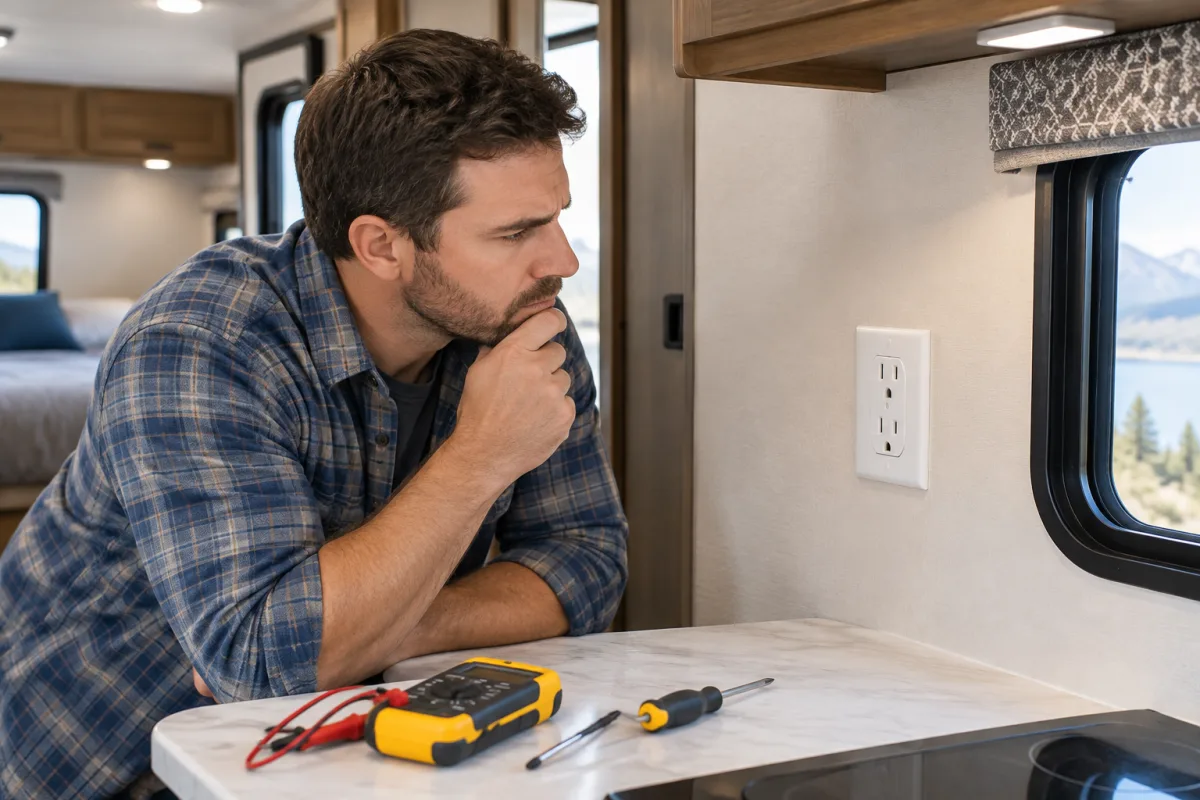
RV outlets use 120-volt AC power, while many RV lights, water pumps, and control systems use a separate 12-volt DC system. That is why the lights may work even when every household-style outlet is dead.
The cause is usually a loss of shore or generator power, a tripped breaker or GFCI receptacle, a damaged shore-power connection, or an inverter problem.
Check the power source first
If all RV outlets have stopped working, confirm how the RV is currently receiving 120-volt power:
- For shore power, make sure the power cord is fully connected to the campground pedestal and the RV inlet.
- Check whether the campground pedestal breaker is on and supplying power.
- If using a generator, confirm that it is running and supplying AC power.
- Inspect the shore-power cord, plug, adapter, and connections for visible damage, looseness, or overheating.
A faulty adapter, open neutral, loose connection, or incorrectly wired pedestal can prevent power from reaching the RV.
Reset the main and branch breakers
RV 120-volt outlets are protected by circuit breakers, not by the 12-volt fuse section of the power center. Locate the RV electrical panel and check the main breaker and branch breakers. A breaker can appear almost on while still being tripped, so switch the suspected breaker fully off and then back on.
If a breaker trips again immediately, stop resetting it. Repeated tripping can indicate an overload, short circuit, or defective appliance.
Find and reset the GFCI outlet
A GFCI receptacle can shut off other outlets downstream on the same circuit. GFCI outlets are commonly found in areas such as kitchens, bathrooms, exterior compartments, or near sinks, although the exact location varies by RV.
Press the reset button on the GFCI receptacle, then test the other outlets. If the GFCI trips again, unplug appliances from that circuit and avoid using it until the cause is identified.
Determine whether the problem affects every outlet
All outlets are dead
When every outlet is without power, focus on the shore-power cord, generator, campground pedestal, main breaker, and the RV’s power center. A problem with the incoming 120-volt supply can affect the entire outlet system.
Only some outlets are dead
When only certain outlets do not work, check the GFCI receptacles and branch breakers first. The affected outlets may be connected downstream from a tripped GFCI or controlled by a separate breaker.
Check the inverter when camping on battery power
If the outlets work on shore power but not when the RV is running from batteries, the inverter system may be the reason. A converter charges the battery and supplies 12-volt DC power; it does not normally provide 120-volt AC power to household outlets. An inverter converts battery power into 120-volt AC power.
Depending on the RV’s electrical design, the outlets may not be connected to the inverter’s subpanel. Also check whether the inverter is turned on, overloaded, improperly connected, or receiving insufficient battery voltage.
Do not confuse a converter problem with an outlet problem
If the converter has no AC input, its output will not operate correctly. Before replacing a converter, the supplying breaker and AC voltage at the converter’s input outlet need to be checked. Because this involves 120-volt components, testing should be performed by a qualified technician.
When to call an RV electrical technician
Professional service is the safest choice when a breaker or GFCI repeatedly trips, the shore-power cord shows heat or damage, outlets remain dead after basic resets, or the issue involves exposed wiring, the inverter, converter, or power center. Do not remove outlet covers or work on live 120-volt wiring unless you are qualified to do so.
Custom way provides RV electrical repair along with RV renovations and related repairs in Orange County, Los Angeles, and Riverside County. The team can inspect an outlet circuit, power-center issue, inverter-related problem, or other RV electrical fault.
Custom way is located at 17223 Roseton Ave, Artesia 90701. For service information, call +1 840-205-7314 or email customway.ca@gmail.com.