How to Repair a Toy Hauler Ramp Door Safely
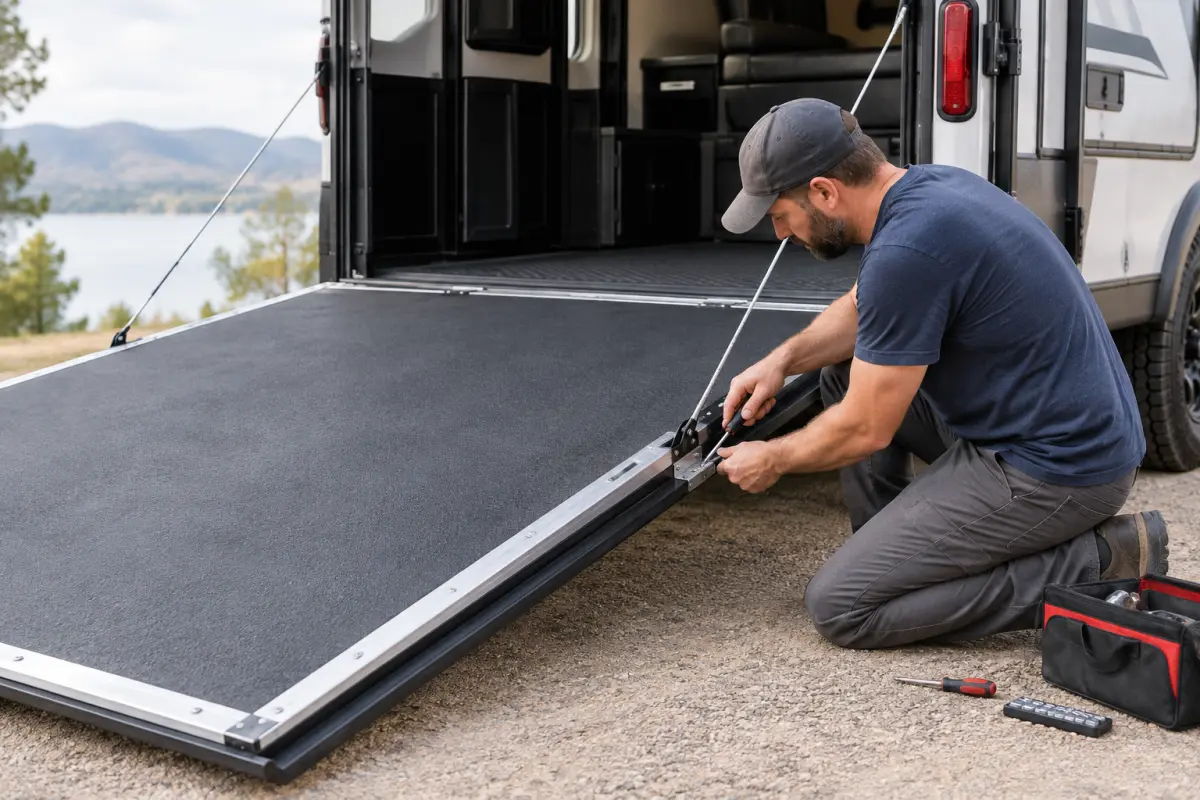
Repairing a toy hauler ramp door starts with identifying the door system and the failed component. Common problems include broken or stretched cables, worn hinges, damaged springs, loose brackets, faulty latches, failed seals, and water damage to the door or rear-wall structure.
Because many ramp doors use springs or torsion mechanisms under substantial tension, do not attempt to tension, remove, or adjust these parts without the correct service information and suitable experience. A released spring or cable can cause serious injury.
Identify the ramp-door system
Toy haulers can use different lifting mechanisms. Before ordering parts or disassembling anything, determine whether the door has:
- Preset springs attached to a hinge assembly
- Separate cables and springs
- Cable-less torsion hinges
- A zero-gravity ramp-door mechanism
Some preset spring systems are designed to support much of the door’s weight and are not adjustable. The correct replacement parts depend on the trailer’s make, model, year, door design, and existing hardware. Check the applicable owner manual or service manual before starting work.
Inspect the door before repairing it
- Secure the trailer. Park on stable, level ground, apply the parking brake, and prevent the trailer from moving.
- Support the ramp door. Do not rely on a damaged spring, cable, hinge, or latch to hold the door safely.
- Inspect the hinge line. Look for bent hinges, missing bolts, separated fasteners, cracked welds, and movement where the door meets the rear wall.
- Check the cables and brackets. Look for fraying, kinks, corrosion, loose attachment points, or a cable that has come off its bracket.
- Examine the springs and lifting mechanism. A door that suddenly becomes heavy may have a broken or stretched spring, failed cable, or damaged torsion component.
- Test the latches and seals. Misaligned latches, torn seals, and gaps around the perimeter can allow water into the door and rear wall.
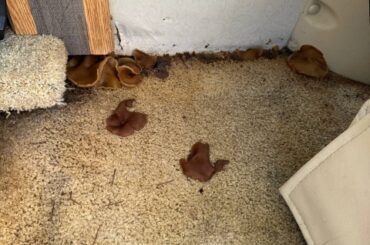
- Look for structural and water damage. Soft flooring, swollen wood, delamination, or separation near the hinge line may indicate a larger repair than a simple hardware replacement.
Match the repair to the failure
Broken or frayed cable
A broken or frayed cable should be replaced with the correct part for the installed ramp-door system. Do not substitute a cable based only on its length or appearance. Cable routing, attachment points, and load requirements must match the manufacturer’s design.
Broken or damaged spring
A ramp door that is unusually difficult to lift may have a failed spring. Some systems use preset springs attached to the hinge assembly, while others use separate spring and cable components. These parts may remain under tension even when the door is open, so inspection and replacement should generally be handled by an experienced trailer-door professional.
Worn hinge or loose hardware
Replace damaged hinges, bolts, washers, or brackets with components specified for the door. Tightening loose hardware may correct a minor problem, but bent hinges, elongated mounting holes, cracked welds, or movement in the rear-wall reinforcement require a more thorough structural inspection.
Damaged seal or latch
Replace torn seals and correct latch alignment so the door closes evenly around its perimeter. A damaged seal can permit water intrusion, while a misaligned latch can place additional stress on the hinges and door frame.
Water-damaged door or frame
Do not treat separation, soft material, sagging, or delamination as cosmetic issues. Moisture may have damaged the door core, flooring, hinge backing, or rear-wall reinforcement. The affected material must be assessed and repaired before new hardware is installed.
Why generic spring instructions are unsafe
There is no universal ramp-door repair procedure. Spring dimensions, cable routing, mounting hardware, adjustment methods, and safety requirements vary by manufacturer and mechanism. Incorrectly releasing or tensioning a torsion spring can cause severe injury and can damage the door or trailer.
Use the exact manual for the toy hauler and ramp-door system. If the manual does not clearly cover the repair, or if the door has a broken spring, cable, hinge, or structural separation, stop using the ramp until it has been inspected by a qualified RV or trailer-door technician.
When to use professional RV repair
Professional service is the safer choice when the ramp door is unusually heavy, will not stay open, is sagging, has a broken cable or spring, has separated from the rear wall, or shows signs of water damage. A technician can identify the mechanism and match replacement hardware instead of relying on a generic part.
In California, Custom way repairs and renovates RVs and camper vans in Orange County, Los Angeles, and Riverside County. Its listed services include RV window replacement, roof repair, water damage repair, flooring, electrical repair, solar installation, and renovations. For a toy hauler with related water, flooring, electrical, or renovation damage, contact Custom way at +1 840-205-7314 or customway.ca@gmail.com.
Custom way is located at 17223 Roseton Ave, Artesia 90701. Have the toy hauler’s make, model, year, photos of the ramp mechanism, and a description of the symptoms ready when arranging an inspection.