Yes, in most RVs the battery should charge when the RV is plugged into shore power. But if the charging system is not working correctly, your outlets may still work while the battery slowly drains.
This is one of the most confusing RV electrical problems. You plug into a campground pedestal or home outlet, everything seems normal, but later the lights get dim, the water pump slows down, or the battery monitor shows low charge.
The short answer is simple: your RV battery charges when plugged in only if the converter charger or inverter charger is working, the battery is connected, and the wiring, fuses, and breakers are in good condition.
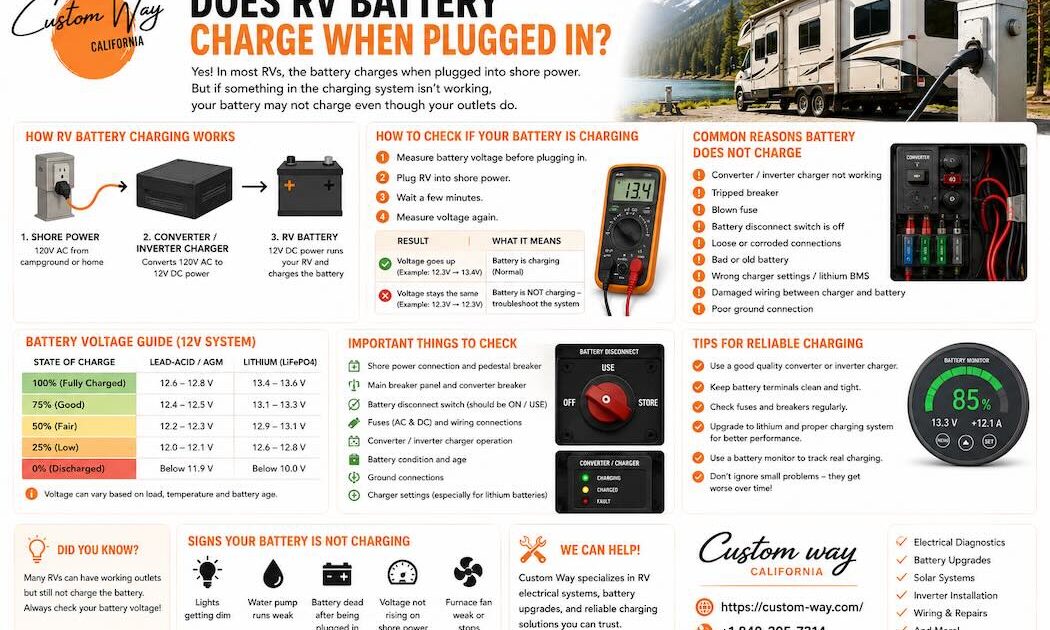
How RV Battery Charging Works
An RV usually has two electrical systems:
- 120V AC system
- 12V DC system
The 120V system powers things like outlets, microwave, air conditioner, and some larger appliances when connected to shore power.
The 12V system powers lights, water pump, furnace fan, refrigerator control board, slide-outs, leveling systems, detectors, and many other RV functions.
When you plug your RV into shore power, the converter charger should take 120V AC power and convert it into 12V DC power. That 12V power runs your DC loads and charges the battery.
In some RVs, this job is handled by an inverter charger instead of a basic converter.
Why the Battery Still Matters When Plugged In
A common mistake is thinking that the RV battery is not important when shore power is connected.
In reality, many RV systems still depend on 12V power even while plugged in.
Your RV may need battery or converter power for:
- Ceiling lights
- Water pump
- Furnace blower
- Thermostat
- Refrigerator control board
- Propane detector
- Tank monitor panel
- Slide-out motors
- Leveling system
- Awning motor
- USB outlets
- Control boards for appliances
So if the battery is not charging, the RV can start acting strange even though you are connected to shore power.
How to Know If Your RV Battery Is Charging
The easiest first check is battery voltage.
Use a multimeter or battery monitor.
Before plugging in, a 12V lead-acid or AGM battery may show around 12.2V to 12.7V depending on charge level. After plugging into shore power, voltage should usually rise above resting voltage.
A working charger may show something like:
- Around 13.2V during float or maintenance charging
- Around 13.6V to 14.4V during active charging
- Different values for lithium depending on charger settings
The exact number depends on battery type, charger model, temperature, and charge stage.
Simple test:
- Measure battery voltage before plugging in.
- Plug the RV into shore power.
- Wait a few minutes.
- Measure voltage again.
If voltage rises, the battery is likely charging.
If voltage stays the same, the charging system may not be reaching the battery.
Can the RV Be Plugged In but Not Charging the Battery?
Yes. This happens often.
Your RV outlets may work because shore power is available, but the battery may not charge if the converter, breaker, fuse, disconnect switch, or wiring has a problem.
Common causes include:
- Converter charger not working
- Tripped breaker
- Blown fuse
- Battery disconnect switch turned off
- Loose battery cable
- Corroded ground connection
- Bad battery
- Wrong charger settings
- Lithium battery protection mode
- Failed inverter charger
- Damaged wiring between charger and battery
This is why “plugged in” does not always mean “charging.”
Check the Battery Disconnect Switch
Many RVs have a battery disconnect switch. It may be near the door, inside a cabinet, close to the battery compartment, or on the control panel.
Some RVs label it as:
- Battery disconnect
- Use / Store
- Battery switch
- Main battery
If this switch is off, the battery may not connect properly to the charging system.
This can create confusing symptoms. The RV may have power from shore connection, but the battery still does not charge.
For normal use and charging, the switch usually needs to be in the “use” position.
Check the Converter Charger
The converter charger is one of the main parts responsible for charging the RV battery when plugged in.
Signs of converter problems include:
- Battery voltage does not rise on shore power
- 12V lights dim over time
- Battery drains while plugged in
- Converter fan never turns on
- Converter breaker trips
- Fuses keep blowing
- Burning smell near electrical panel
- Converter feels unusually hot
A failed converter can make the whole RV feel unreliable. Replacing or upgrading it may be necessary, especially if you are switching to lithium batteries.
Check Fuses and Breakers
RV charging systems usually have both AC breakers and DC fuses.
The converter needs 120V power to operate. If its breaker is tripped, it cannot charge the battery.
There may also be DC fuses between the converter and battery. If one is blown, the converter may work, but the battery will not receive charge.
Check:
- Main breaker panel
- Converter breaker
- DC fuse panel
- Reverse polarity fuses
- Inline battery fuse
- Battery compartment fuse or breaker
- Loose fuse holders
A fuse may look good but still be bad, so testing with a multimeter is better than guessing.
What About Lithium Batteries?
Lithium batteries are excellent for RVs, but they need compatible charging equipment.
If you install lithium batteries and keep an old lead-acid converter, the battery may not charge fully or may charge incorrectly.
Lithium charging issues can happen because of:
- Old converter not designed for lithium
- Wrong charge profile
- Battery management system blocking charge
- Battery too cold to charge
- Loose communication wiring in smart systems
- Incorrect inverter charger settings
- Battery monitor not calibrated
Some lithium batteries have low-temperature charging protection. If the battery is too cold, the BMS may block charging to protect the cells.
In that case, the RV may be plugged in, but the lithium battery will not accept charge.
Can You Leave an RV Plugged In All the Time?
It depends on the charger and battery type.
A modern multi-stage charger can usually maintain a battery better than an old single-stage converter. Old converters may overcharge lead-acid batteries if left plugged in for long periods.
For flooded lead-acid batteries, you also need to check water levels. Long-term charging can cause water loss.
For AGM and lithium, maintenance needs are different, but charger compatibility is still important.
If your RV stays plugged in at home or in storage, a proper charger setup matters. A bad charger can shorten battery life.
Will the Battery Charge From a Regular Home Outlet?
Yes, if the RV is connected correctly and the charger is working.
But a standard household outlet has limited power. It can usually support battery charging and small loads, but it may not safely run heavy appliances like air conditioning unless the system is designed for it.
For home connection, use the correct RV adapter, proper extension cord size, and avoid overloaded circuits.
If the battery is not charging from a home outlet, check whether the RV is actually receiving power and whether the converter charger turns on.
Why Battery Voltage Drops Even While Plugged In
If the RV battery voltage drops while plugged in, something is wrong.
Possible causes:
- Converter is not producing charge voltage
- Battery disconnect is off
- DC fuse is blown
- Battery is failing
- Large 12V loads are exceeding charger output
- Shore power is unstable
- Poor ground connection
- Charger is in the wrong mode
- Lithium BMS is blocking charge
A healthy system should not let the battery drain under normal plugged-in use.
Best Way to Monitor Charging
A basic control panel with four lights is not enough for serious battery monitoring.
A better setup includes:
- Digital voltmeter
- Battery monitor with shunt
- Smart lithium battery app
- Inverter charger display
- Solar charge controller app
A shunt-based battery monitor is especially useful because it shows real current going in and out of the battery.
With a proper monitor, you can see whether the battery is actually charging, how many amps are going in, and how much capacity remains.
Common Signs Your RV Battery Is Not Charging Properly
Watch for these symptoms:
- Battery dead after being plugged in overnight
- Interior lights dimming
- Water pump slowing down
- Furnace fan weak or stopping
- Battery monitor stuck at low charge
- Battery voltage not increasing on shore power
- Converter fan never operating
- Repeated blown fuses
- Refrigerator control errors
- Slide-outs moving slowly
These signs usually mean the charging system needs inspection.
Custom way Can Help With RV Battery Charging Problems
At Custom way, we help RV owners diagnose and repair charging problems so the electrical system works reliably on the road and at campgrounds.
We can help with:
- RV battery charging diagnostics
- Converter charger testing and replacement
- Inverter charger setup
- Lithium battery upgrades
- Solar system installation
- Battery monitor installation
- DC wiring repair
- Fuse and breaker inspection
- Battery drain diagnostics
- Full RV electrical system upgrades
Sometimes the problem is simple. Sometimes the issue is hidden in old wiring, poor grounding, incorrect battery upgrades, or a failing converter. We inspect the full charging path instead of replacing parts blindly.
So, Does an RV Battery Charge When Plugged In?
Yes, it should.
When everything is working correctly, plugging your RV into shore power should allow the converter charger or inverter charger to recharge the battery and support the 12V system.
But if the battery is not charging, do not assume shore power alone is enough. Check the converter, disconnect switch, fuses, breakers, battery condition, and wiring.
A reliable charging system keeps your lights on, your water pump working, your fridge controls powered, and your RV ready for the next trip.