How to Service a Camper AC: A Safe Maintenance Guide
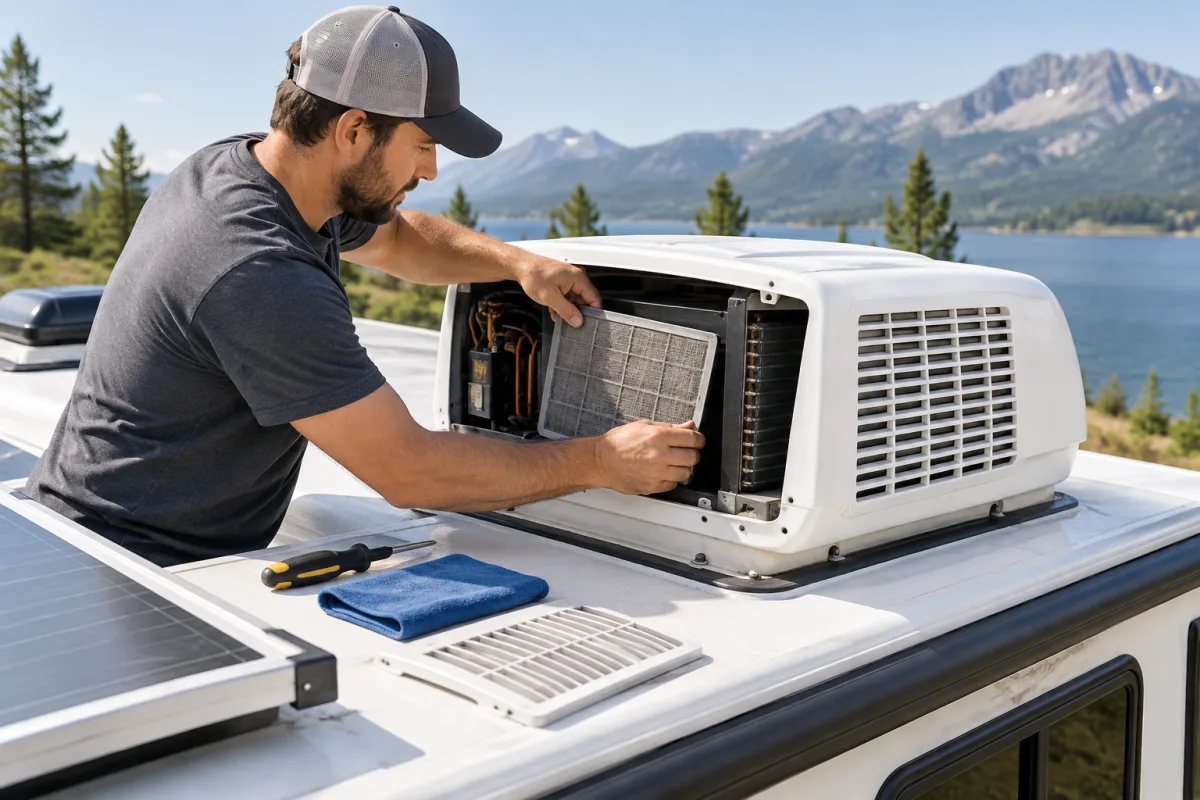
Regular camper AC service helps maintain airflow, cooling performance, and reliable operation. The safest routine maintenance includes cleaning the return-air filter, inspecting the rooftop unit, clearing debris from the condenser coil, and checking the thermostat. Exact procedures and service intervals vary by brand and model, so consult the camper air conditioner manual before removing any panels or parts.
What you need before servicing a camper AC
- The camper AC or RV air conditioner manual
- A replacement filter if the existing filter is damaged
- Warm water and mild soap
- A soft brush or cloth
- Low-pressure compressed air, if available
- A ladder and suitable personal protective equipment for safe rooftop access
1. Disconnect all power
Turn off the air conditioner and disconnect all power to the vehicle and AC before cleaning the rooftop unit or condenser coil. This includes the relevant electrical supply and any other power source connected to the camper. Do not begin work while the fan or compressor can start unexpectedly.
2. Clean or replace the return-air filter
The return-air filter collects dust before air reaches the evaporator and blower. Custom way recommends inspecting the filter monthly and cleaning it when necessary. Dusty environments may require more frequent attention. Dometic gives different intervals for different use patterns on its referenced Brisk unit: approximately every two months for full-time users and every six months for seasonal campers.
- Remove the filter according to the instructions for your AC model.
- Wash a reusable filter with warm water or mild soap.
- Allow the filter to dry completely.
- Reinstall it in the correct orientation.
Never operate the camper AC without its filter. Replace a filter if it is torn, badly deformed, or no longer fits securely.
3. Inspect the rooftop air conditioner
With the power disconnected, inspect the rooftop cover and visible air passages. Remove leaves, twigs, insects, and other loose debris carefully. Look for cracked covers, loose components, blocked openings, or signs of water intrusion. Do not remove sealed refrigeration-system components unless the manual specifically requires it and you have the necessary qualifications.
4. Clean the condenser coil
The exterior condenser coil should be cleaned at least once a year, or more often when the camper is used in dusty conditions. Blocked airflow can reduce cooling performance and make the AC work harder.
- Disconnect all power before accessing the coil.
- Remove loose debris gently.
- Blow dust out carefully with low-pressure air, or wash the coil with water when appropriate for the model.
- Keep the airflow direction from driving debris deeper into the coil.
- Allow the area to dry before restoring power.
Do not use a pressure washer. High pressure can bend the fins or damage the coil. If the fins are bent, straighten them carefully with a suitable fin tool without crushing or tearing them.
5. Check airflow and thermostat operation
After the filter and coil are clean and dry, restore power and test the unit. Check that air moves freely through the return and supply vents, the fan operates normally, and the thermostat responds to temperature adjustments. Weak airflow may indicate a blocked filter, dirty coil, damaged fan component, or another model-specific fault.
6. Know what not to repair yourself
Camper AC electrical and refrigeration repairs require more than routine cleaning. Leave wiring, capacitors, control boards, compressors, and other electrical repairs to a qualified technician. A suspected low refrigerant charge also needs professional evaluation. AC systems are designed as closed, sealed systems that normally do not require recharging, so adding refrigerant is not a standard DIY maintenance step.
How often should a camper AC be serviced?
- Monthly: inspect the air filter and clean it when needed, especially in dusty conditions.
- Every two to six months: follow the interval appropriate for your usage pattern and the AC manufacturer’s instructions.
- At least annually: inspect and clean the exterior condenser coil.
- Before heavy seasonal use: test airflow, thermostat operation, rooftop condition, and visible wiring or components.
Your specific manual takes priority because filter access, coil layout, drain design, service intervals, and replacement parts differ between camper AC models.
Professional camper AC and RV service in Southern California
For broader RV or camper work in Orange County, Los Angeles, and Riverside County, Custom way repairs and renovates RVs and camper vans. Its services include electrical repair, roof repair, water damage repair, flooring, solar installation, RV window replacement, and renovations. These services can be useful when an AC problem is connected to roof damage, water intrusion, electrical faults, or a wider camper renovation.
Custom way is located at 17223 Roseton Ave, Artesia 90701. For service inquiries, call +1 840-205-7314 or email customway.ca@gmail.com.