Should You Upgrade Your RV Batteries to Lithium?
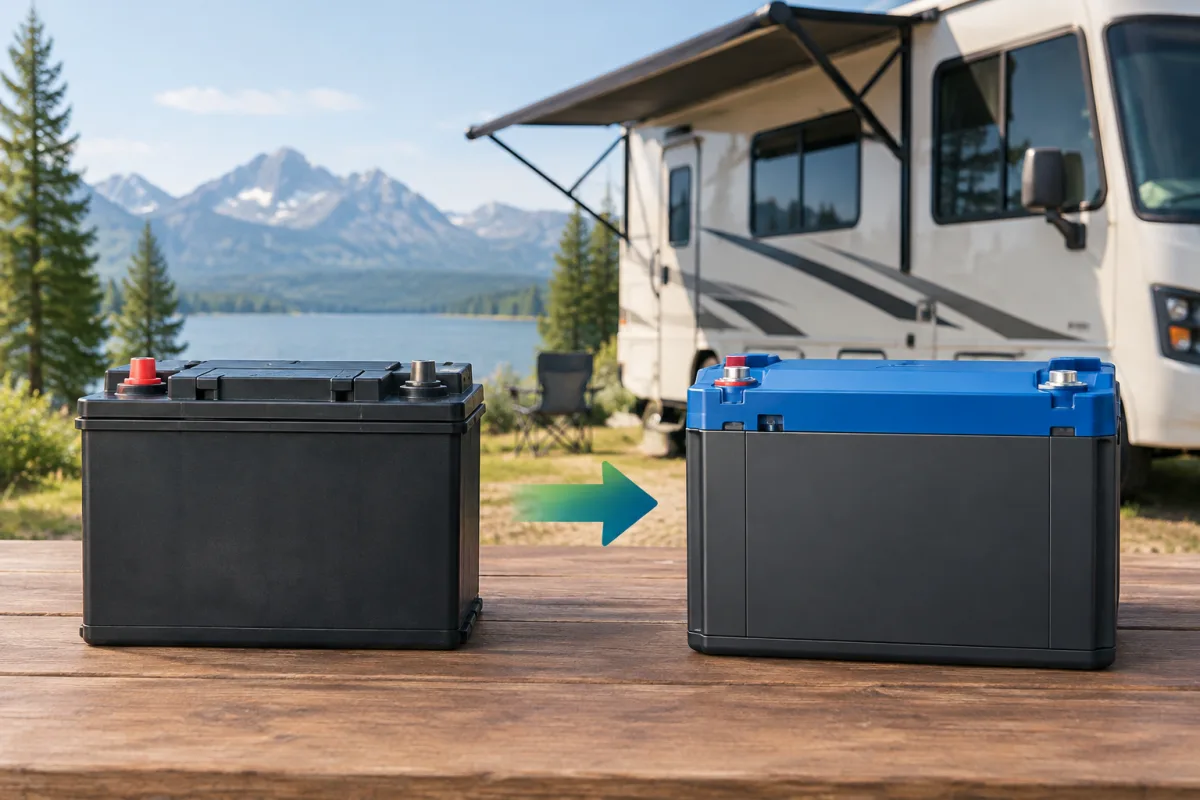
Upgrading RV batteries from lead-acid to lithium iron phosphate (LiFePO4) can provide more usable energy, faster charging, and better performance during boondocking. However, it is not always a simple battery replacement. Your RV’s charging equipment, wiring, fuses, alternator circuit, and monitoring system may also need to be checked or upgraded.
The right decision depends on how you use the RV, how much power you need, and whether the existing electrical system is compatible with lithium charging.
When a lithium upgrade makes sense
Lithium is usually worth considering when you frequently camp without hookups, need more usable capacity in a limited battery compartment, or want to recharge more quickly. The practical case is weaker when the RV is almost always connected to shore power and the existing lead-acid batteries already meet your needs.
- Frequent boondocking: LiFePO4 batteries provide more usable energy before recharging is necessary.
- Limited battery space: Lithium can offer greater usable capacity without requiring a larger battery compartment.
- Faster charging: Lithium batteries accept charging current more readily than lead-acid batteries.
- More consistent output: Voltage generally remains more stable as the battery discharges.
What are the drawbacks?
The initial purchase and installation cost can be higher than replacing lead-acid batteries with similar lead-acid models. Total cost depends on battery capacity, battery brand, converter type, alternator setup, solar equipment, wiring, and installation labor, so there is no reliable universal upgrade price.
Lithium batteries also have specific charging requirements. Cold-weather charging limits vary by model, and the battery manual must be checked for low-temperature protection and permitted operating temperatures.
Can you simply replace the batteries?
Often, no. The shore-power converter, inverter-charger, and solar charge controller must support an LFP or configurable lithium charging profile. Lead-acid equalization settings should not be used with LFP batteries.
The upgrade may also require changes to the alternator charging circuit, battery-management system, wiring, fuses, and monitoring equipment. Compatibility cannot be confirmed without the RV’s make, model, year, battery-bank voltage, converter or inverter-charger model, solar-controller model, and alternator-charging configuration.
Alternator charging requires special attention
A lithium house battery should not normally be connected directly to an RV alternator. Its low internal resistance can allow it to draw high current for an extended period, potentially overheating or damaging the alternator.
A current-limiting DC-DC charger is the preferred method for charging an RV lithium battery from the alternator. The charger limits current and provides a lithium-specific charging profile. The Victron Orion XS is one example designed for RV service-battery charging; it supports lithium profiles, input-current limiting, and automatic charging shutdown at sub-zero temperatures.
Check the converter, inverter-charger, and solar controller
Every charging source needs to be reviewed before installation:
- Shore power: Confirm that the RV converter or inverter-charger has a lithium setting or a charging profile compatible with the selected battery.
- Solar: Check that the solar charge controller supports LFP charging and that its settings match the battery manufacturer’s specifications.
- Alternator: Use a properly sized DC-DC charger rather than connecting the lithium battery directly to the alternator.
- Wiring and fuses: Verify that cables, circuit protection, and connections can safely handle the expected current.
- Monitoring: Make sure the battery monitor and other controls can accurately track lithium battery operation.
The Victron Blue Smart IP65 Charger, for example, offers configurable charging algorithms for different battery chemistries, including lithium. The selected charging profile still needs to match the battery manufacturer’s requirements.
Pay attention to converter output and existing wiring
A replacement lithium converter with a higher amp rating than the original converter may exceed the safe capacity of the RV’s existing wiring. Progressive Dynamics specifically cautions that the replacement converter’s DC output rating should not exceed the original rating unless the wiring has been confirmed capable of handling the additional current.
Progressive Dynamics produces lithium replacement converter sections for several RV converter series and lists options for Progressive Dynamics, WFCO, IOTA, and PowerMax models. The correct replacement depends on the converter already installed in the RV.
What should you inspect before buying?
- Record the RV make, model, and year.
- Identify the battery-bank voltage and the number and type of existing batteries.
- Find the model number of the converter or inverter-charger.
- Check the solar charge controller model and its available charging profiles.
- Review the alternator-charging circuit and determine whether a DC-DC charger is already installed.
- Inspect cable sizes, fuses, disconnects, and battery-compartment space.
- Read the selected battery’s requirements for temperature protection and charging current.
When professional installation is worthwhile
A professional inspection is especially valuable when the RV has solar power, an inverter, multiple charging sources, an older converter, or an alternator-charging circuit that has not been modified before. Incorrect settings or undersized wiring can reduce performance and create electrical and thermal risks.
Custom way repairs and renovates RVs and camper vans in California, including electrical repair, solar installation, and broader RV renovations. The company serves Orange County, Los Angeles, and Riverside County. You can visit Custom way at 17223 Roseton Ave, Artesia 90701, call +1 840-205-7314, or email customway.ca@gmail.com for an RV electrical-system assessment related to a lithium conversion.
Is lithium right for your RV?
Choose lithium when frequent boondocking, limited battery space, and faster charging justify the added system work and expense. Staying with lead-acid may be more practical when the RV is mainly used at campgrounds with shore power and the current system already provides enough capacity.
Before purchasing, evaluate the complete charging system rather than comparing battery prices alone. A safe upgrade must account for the converter or inverter-charger, solar controller, alternator circuit, DC-DC charging, wiring, fuses, battery-management system, monitoring, and temperature protection.